
Acceptance and Commitment Therapy in Manchester
Practical Hypnotherapy with an ACT-Informed Framework
Acceptance and Commitment Therapy (usually known as ACT) is a modern, evidence-based behavioural therapy that helps people build psychological flexibility: the ability to notice difficult thoughts, feelings, urges, and sensations without being pushed around by them. The goal is to take committed action in the direction of what matters.
ACT is not about forcing positive thoughts or trying to feel calm all the time. It is about changing your relationship with difficult inner experiences so they have less control over your choices.
I’m Adrian Tannock, a CNHC-registered hypnotherapist based in Manchester city centre. Since 2005, I have helped adults with anxiety, overthinking, confidence, phobias, smoking, habits, procrastination, and other patterns that can keep life feeling narrowed or stuck.
At Lasting Change Hypnotherapy Manchester, I combine hypnotherapy with ACT-informed therapeutic work. This means we may use hypnosis, therapeutic conversation, practical exercises, mental rehearsal, and between-session reflection to help you understand what keeps a problem going and develop new ways of responding in everyday life.

CNHC registered · Senior member of the General Hypnotherapy Register · Practising hypnotherapy in Manchester since 2005 · Private office on Deansgate · Registered and insured to practise
What ACT Is Trying to Help With
Many people come to therapy because they are caught in a struggle with their own internal experience.
They may be trying to get rid of anxiety, stop overthinking, force themselves to feel confident, control urges, suppress uncomfortable memories, or wait until they feel ready before taking action. These efforts are completely understandable. The problem is that they can sometimes make life smaller.
For example, a person may avoid situations that trigger anxiety, but then lose confidence. They may criticise themselves for procrastinating, but then feel even more overwhelmed. They may try to push away an unwanted thought, only to find that it keeps returning. They may wait to feel calm, certain, or motivated before acting, and then find that life stays on hold.
ACT helps by changing the focus. Instead of treating every difficult thought or feeling as something that must be eliminated before life can move forward, we look at how you can respond differently and take useful action in the presence of discomfort.
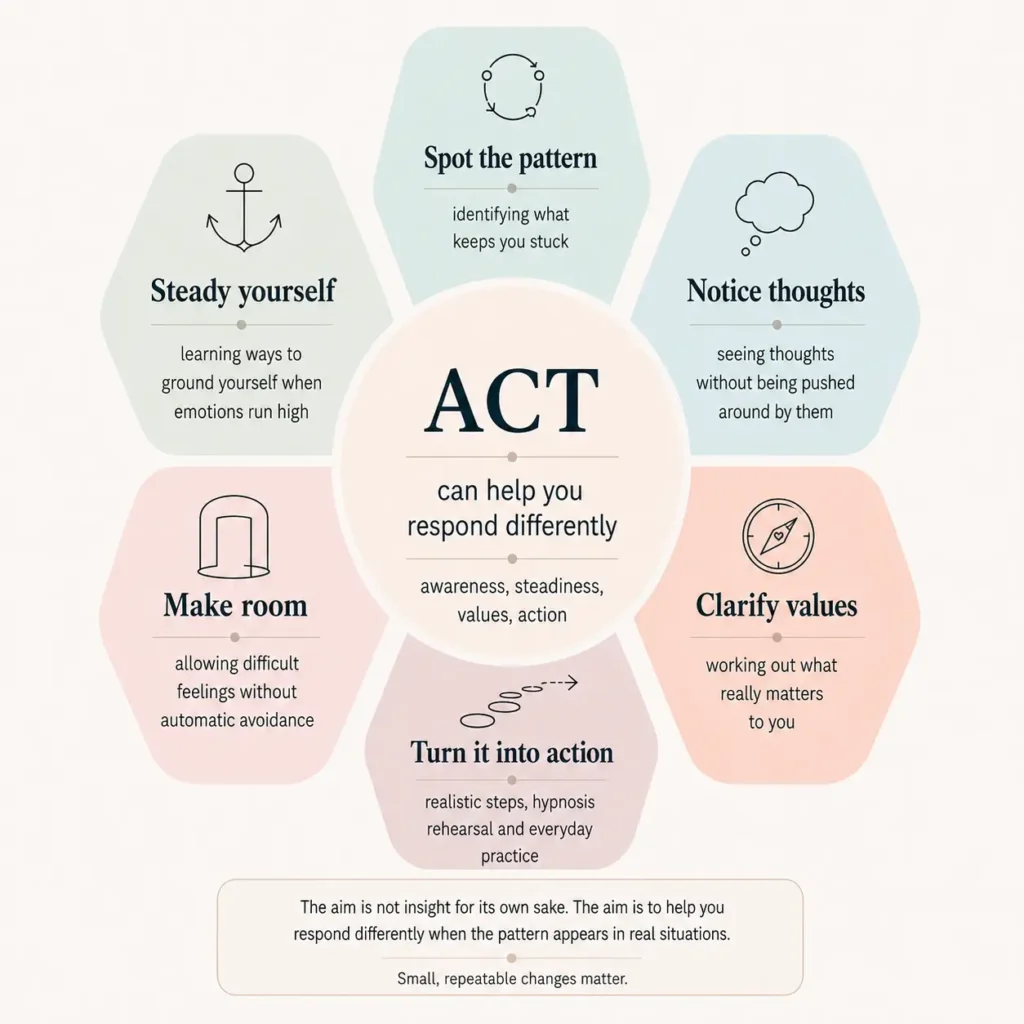
In practice, ACT might involve mapping the pattern that keeps you stuck, learning how to notice thoughts and urges without automatically following them, practising steadier responses to discomfort, clarifying what matters to you, and taking small steps that move life in that direction.
ACT, Hypnotherapy and Psychological Flexibility
Therapy usually begins with making sense of what is happening. This does not mean reducing you to a label or forcing your experience into a neat category. It means understanding the pattern: what tends to trigger the problem, what thoughts and feelings show up, what you do in response, what brings short-term relief, and what keeps the difficulty going over time.
We may look at questions such as:
- What tends to trigger the problem?
- What does your mind say in those moments?
- What happens in your body?
- What do you usually do to cope, avoid, escape, or control the experience?
- What helps briefly but creates problems later?
- What has the pattern started to cost you?
- What would you like to be different in your life?
This kind of shared understanding is important. It helps therapy become more precise, more collaborative, and more relevant to your actual life.
Feeling Understood, Not Judged
People often arrive in therapy feeling frustrated with themselves. They may think they should be stronger, more disciplined, less anxious, more confident, or better able to cope.
An ACT-informed approach starts from a different place. Rather than treating the problem as a personal failing, we look at how the pattern has developed and why it may have made sense in the short term. Avoidance, reassurance-seeking, procrastination, smoking, overthinking, or self-criticism often begin as attempts to manage discomfort, threat, or uncertainty.
That does not mean the pattern is helpful. It means we can understand it without shame.
This matters because shame and self-attack often make change harder. When you can see the pattern more clearly and respond to yourself with more steadiness, it becomes easier to make useful choices rather than simply repeat the old cycle.
Practical Support, Not Abstract Theory
ACT can sound philosophical, but in reality it is very practical. Depending on your needs, the work may include:
- identifying the pattern that keeps you stuck
- learning ways to steady yourself when emotions are high
- noticing thoughts without being pushed around by them
- making room for difficult feelings without automatically avoiding them
- clarifying what matters to you
- turning values into realistic goals and actions
- rehearsing new responses in hypnosis
- building small, repeatable steps into everyday life
- learning to respond to yourself with more patience and self-respect
The aim is not to collect insights for their own sake. It is to help you respond differently when the pattern appears in real situations.
Getting Grounded When Emotions Take Over
When anxiety, shame, anger, panic, or overwhelm rises, it can feel as though the mind and body have taken over. At those times, it is often hard to think clearly or choose your response.
Part of the work may involve learning how to steady yourself and reconnect with the present moment. This might include slowing down, noticing your body, orienting to the room, breathing more steadily, or finding a point of contact with the here and now.
This is not about pretending the feeling is not there. It is about becoming less swept away by it.
Hypnosis can support this process by helping you practise a more settled internal state, rehearse difficult moments, and experience what it is like to respond from a steadier position.
Relating Differently to Thoughts and Feelings
Many people try to win an argument with their own mind. They try to prove anxious thoughts wrong, replace negative thoughts with positive ones, suppress unwanted feelings, or wait until confidence arrives before acting. Sometimes that helps briefly. Often, it keeps attention locked on the struggle.
ACT takes a different approach. We may work on noticing thoughts as thoughts, feelings as feelings, and urges as urges. They may be powerful, uncomfortable, or persuasive, but they do not have to dictate your behaviour.
This can be especially useful across patterns such as anxiety and overthinking, low confidence and self-criticism, procrastination and avoidance, smoking and other habits, phobias and panic, jealousy or insecurity, and stress or emotional overwhelm.
The aim is not to become emotionless or endlessly calm. It is to have more choice in how you respond.
What Matters, and What You Want to Move Towards
ACT places strong emphasis on what matters to you: the qualities, directions, and commitments that give life meaning.
In therapy, this means we do not only ask, “What symptoms do you want to reduce?” We also ask, “What do you want to move towards?” and “What would you be doing differently if this pattern had less control?”
For one person, that might mean speaking more freely in meetings. For another, it might mean travelling again, stopping smoking, becoming more present with family, taking better care of their health, finishing important work, or living with more honesty and self-respect.
These directions are then translated into practical action. We may identify small steps, prepare for obstacles, rehearse new responses, and build a plan that can be used outside the therapy room.
Self-Compassion and Change
Many people try to change by attacking themselves. They tell themselves they are lazy, weak, stupid, broken, too sensitive, or not good enough. This may create pressure, but it rarely creates lasting freedom. More often, it adds another layer of threat and avoidance.
Self-compassion does not mean making excuses or avoiding responsibility. It means learning to relate to yourself in a way that supports change rather than sabotages it. In practice, this may involve noticing self-critical thoughts, softening the way you respond to setbacks, and returning to useful action without turning every difficulty into evidence that you have failed.
This is especially important when working with long-standing patterns. Progress is rarely perfect. The aim is to build a more workable relationship with yourself so that you can keep moving in the right direction.
How ACT and Hypnotherapy Work Together
ACT and hypnotherapy can complement each other well. ACT provides the direction of the work: less struggle with inner experience, more movement towards what matters. Hypnosis can support this by helping you rehearse new responses, absorb useful perspectives, and practise meeting difficult moments from a steadier position.
Used together, the aim is not simply to talk about change or relax for a short time. It is to help you experience and practise new ways of responding, so that those responses become more available in everyday life.
Issues This Approach Can Help With
I use ACT-informed hypnotherapy with a range of issues, including:
- anxiety and overthinking
- panic and fear responses
- low confidence and self-esteem
- procrastination and avoidance
- phobias and fear of flying
- smoking and habit change
- self-criticism and perfectionism
- obsessive thoughts and unhelpful loops
- relationship insecurity, jealousy, and self-doubt
This list is not exhaustive. Many people come with difficulties that overlap several categories. Part of the consultation is to understand your situation clearly and decide whether this approach seems suitable.
What to Expect If We Work Together
The first step is usually a consultation. We will talk through what is happening, how it affects your life, what you have already tried, and what you would like to change.
If we decide to work together, sessions are tailored to you. We may use therapeutic conversation, hypnosis, practical exercises, mental rehearsal, and between-session reflections or actions where helpful.
The work is collaborative. I will not simply tell you what to do, and hypnotherapy is not something done to you while you remain passive. We will aim to understand the pattern together and work out what would help you move forward.
You can also read more on my page about What to Expect from Hypnotherapy.
When to Seek Additional Support
Hypnotherapy and ACT-informed work can be helpful for many patterns, but they are not a substitute for urgent or necessary medical or mental health care.
If your symptoms are severe, sudden, medically unexplained, or you are unsure what kind of help you need, it is sensible to speak with your GP or another appropriate healthcare professional. If you feel at risk or need urgent support, please seek immediate help through the appropriate NHS or emergency services.
Contact me
Please use this form for general enquiries. I will use the details you provide to respond to your enquiry in line with my Privacy Policy. This form is not monitored for urgent or crisis support.
Arrange a consultation
If you are considering acceptance and commitment therapy, or ACT-informed hypnotherapy, you are welcome to get in touch and arrange a consultation. It is free, lasts up to 60 minutes, and can take place online or at my private Manchester city centre office on Deansgate.
We can talk through what is happening, what you would like to change, and whether this approach is likely to suit you. There is no pressure to decide on the spot. Sessions themselves can also be held online or in person.
To take the next step, use the enquiry form or call me on 07790 506375.