Relationship Insecurity Therapy in Manchester
Relationship insecurity can feel exhausting when your mind keeps searching for signs that something is wrong. A delayed reply, a change in tone, a social media post, a past betrayal, or a moment of distance can trigger anxiety, jealousy, checking, reassurance-seeking, or fear of abandonment.
For some people, the pattern shows up as relationship anxiety or anxious attachment. For others, it appears as jealousy, mistrust, overthinking, emotional reactivity, testing a partner, or struggling to feel secure even when there is no clear evidence of danger.
I’m Adrian Tannock, a CNHC-registered hypnotherapist based in Manchester city centre. Since 2005, I have helped adults with anxiety, low self-esteem, jealousy, insecurity, reassurance-seeking, self-consciousness, and related patterns using practical, psychologically informed hypnotherapy tailored to the person rather than a one-size-fits-all script.
My aim is not to tell you that your feelings are irrational or that you should simply trust more. It is to help you understand the insecurity pattern clearly, respond differently when it is triggered, and build steadier ways of relating to yourself and others.

CNHC registered · Senior member of the General Hypnotherapy Register · Practising hypnotherapy in Manchester since 2005 · Private office on Deansgate · Registered and insured to practise
Jealousy, Reassurance-Seeking, and Attachment Anxiety
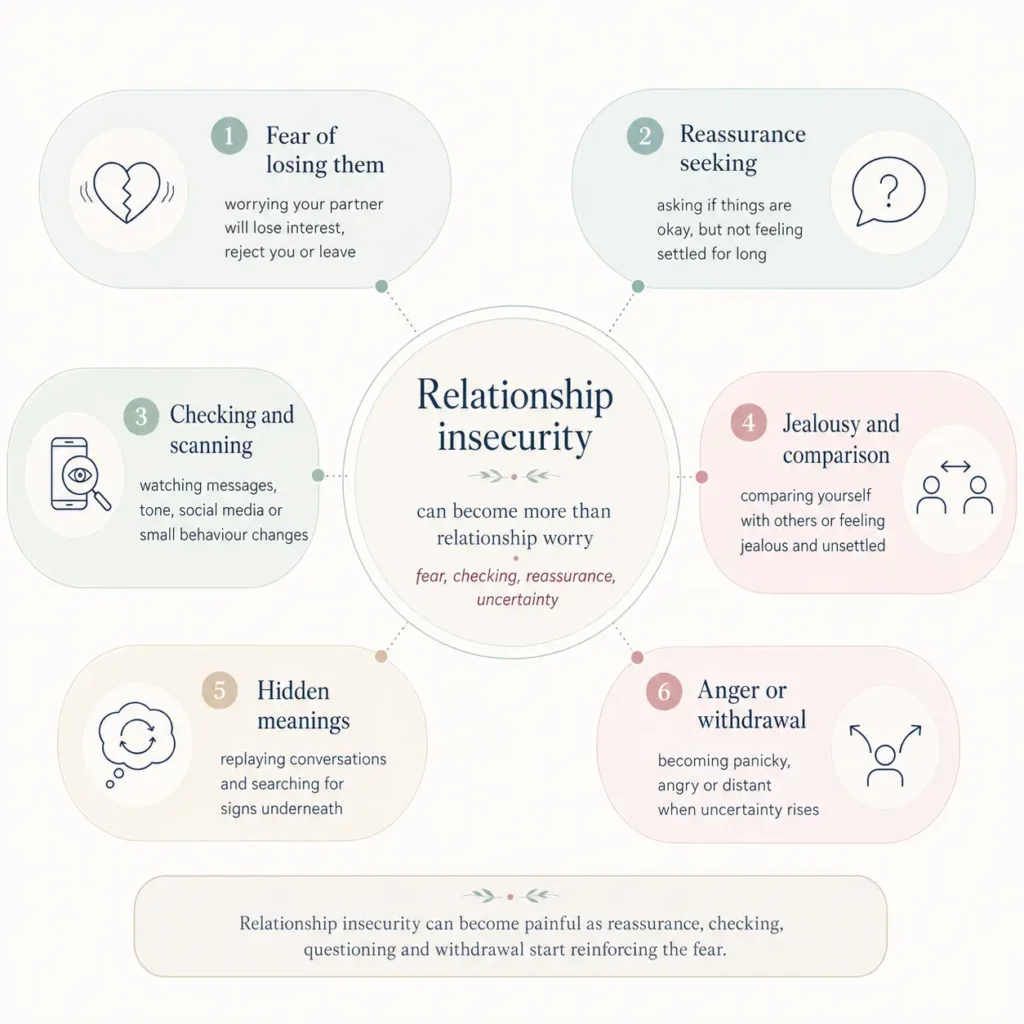
Relationship insecurity does not always look the same from the outside. Some people become anxious, clingy, or reassurance-seeking. Others withdraw, shut down, test their partner, become angry, or try to protect themselves by staying emotionally guarded.
You may recognise some of the following:
- worrying that your partner will lose interest, reject you, or leave
- feeling anxious when messages are delayed or communication changes
- needing frequent reassurance that everything is still okay
- checking social media, phone activity, tone of voice, or small changes in behaviour
- comparing yourself with other people
- feeling jealous even when part of you knows the reaction may be disproportionate
- replaying conversations and looking for hidden meanings
- asking questions repeatedly but still not feeling reassured for long
- becoming angry, withdrawn, or panicky when you feel uncertain
- fearing abandonment, betrayal, or humiliation
- struggling to relax in a relationship even when things are going well
- feeling ashamed of your reactions but unable to stop them in the moment
Relationship insecurity can become painful not only because of the fear itself, but because of what people do to escape the fear. Reassurance, checking, questioning, withdrawing, or trying to control uncertainty may help briefly, but can make the pattern stronger over time.
How Relationship Insecurity Can Keep Itself Going
Relationship insecurity is often maintained by a cycle of threat prediction, emotional alarm, reassurance-seeking, and short-term relief.
Something triggers uncertainty. The mind begins to search for danger: “They are pulling away”, “I am not enough”, “They prefer someone else”, or “I need to know for sure”. The body reacts as though the relationship is under threat, and the urge to check, ask, analyse, or seek reassurance becomes stronger.
A self-reinforcing pattern can develop: a message, tone, silence, or situation triggers insecurity; the mind predicts rejection, betrayal, or abandonment; the body becomes anxious, tense, or emotionally flooded; attention narrows around the relationship threat; you check, question, seek reassurance, test, or withdraw; relief follows briefly if reassurance arrives or the threat seems to pass — and each time, the insecurity pattern becomes a little more believable and more likely to return.
Over time, reassurance can lose its effect. You may feel calmer for a while, but then another doubt appears. The problem becomes less about one specific question and more about a repeated attempt to get certainty where certainty is never complete.
The issue is not simply “being needy” or “being jealous”. It is often a learned protection pattern involving attachment fear, self-esteem, threat sensitivity, past experiences, emotional regulation, and difficulty tolerating uncertainty.
When Insecurity Is Not Just “in Your Head”
It is important to be careful here. Relationship anxiety is not always irrational. Sometimes insecurity is responding to real problems: dishonesty, betrayal, emotional unavailability, manipulation, coercive control, intimidation, repeated boundary violations, or an unsafe relationship.
Therapy should not be used to talk you out of accurate perception or make you tolerate harmful behaviour.
Part of the work may involve separating the insecurity pattern from the reality of the relationship. We may look at what is old fear, what is present evidence, what boundaries are needed, and what kind of relationship would support your wellbeing and self-respect.
If there is violence, coercive control, stalking, intimidation, or risk to your safety, specialist support may be needed. If you are in immediate danger, call 999.
How Hypnotherapy May Help with Relationship Insecurity
Relationship insecurity therapy is not simply about trying to think positively, suppress jealousy, or force yourself to trust. The work is usually more useful when it addresses the wider pattern: what triggers the fear, what your mind predicts, what happens in your body, and what you do to manage uncertainty.
My work is informed by Acceptance and Commitment Therapy (ACT), which helps people respond more flexibly to difficult thoughts, feelings, and bodily sensations while taking action guided by what matters to them. You can read more on my Acceptance and Commitment Therapy in Manchester page.
In relationship insecurity, this might mean noticing thoughts such as “I’m not enough” or “I need to know for sure” without immediately checking, interrogating, or seeking reassurance. The aim is not to force anxious or jealous feelings to disappear before you can live differently. It is to help you build more choice in the moments when insecurity is triggered, so your responses are guided more by steadiness, honesty, self-respect, and connection than by fear.
Depending on your needs, the work may involve:
- understanding your relationship insecurity pattern clearly — its triggers, predictions, and maintaining responses
- reducing the grip of anxious or jealous thoughts
- using hypnosis to support calmer, steadier responses to uncertainty, distance, or perceived rejection
- reducing reassurance-seeking, checking, comparison, or testing behaviours
- working with fear of abandonment and anxious attachment patterns
- developing a steadier relationship with self-worth
- mental rehearsal for conversations, conflict, distance, or uncertainty
- developing clearer boundaries and more grounded communication
- working out what a healthier relationship with yourself and others would make possible
- small between-session practices, where helpful
Hypnosis can support this work by helping you rehearse calmer, more flexible responses to situations that currently trigger insecurity. For example, we might practise noticing the thought “I need to know for sure” as a thought, making room for some uncertainty, and choosing a response that fits the kind of partner or person you want to be.
A Brief Example of How the Work May Unfold
Someone might come for help because they become anxious when their partner takes longer than usual to reply. On the surface, they may describe the problem as, “I know I’m overthinking, but I can’t stop checking.”
When we look more closely, the pattern usually has several parts: noticing a delay or change of tone, interpreting it as a sign of rejection or possible betrayal, and feeling anxious or emotionally flooded. This tends to lead to checking the phone repeatedly, replaying recent conversations, and comparing themselves with other people. Asking for reassurance brings only brief calm, and shame, anger, or a sense of neediness often follows.
The work would then address the pattern from several angles. We might look at the fear predictions involved, how uncertainty affects the body, what reassurance-seeking does in the short and long term, and what the person wants to be able to do differently when insecurity appears.
Hypnosis may be used to rehearse a steadier internal response, strengthen self-trust, and support a different relationship with uncertainty, jealousy, and the urge to check. The work is not only about feeling less anxious in relationships. It is also about helping the person act with more clarity, dignity, and choice when attachment fear is triggered.
When This Approach May Be a Good Fit
This approach may suit you if relationship insecurity, jealousy, attachment anxiety, or reassurance-seeking is affecting your wellbeing, confidence, or relationships, and you want therapy to be practical, collaborative, and focused on meaningful change.
You do not need to arrive with everything neatly understood. Many people feel confused, ashamed, or conflicted about relationship insecurity. Part of the work is to make sense of the pattern without judging it.
This approach may be especially relevant if your difficulty is linked with anxious attachment, fear of abandonment, trust issues, low self-esteem, social comparison, overthinking, emotional reactivity, people-pleasing, jealousy, or difficulty tolerating uncertainty.
What helps is a willingness to look honestly at the pattern, try new ways of responding, and, where appropriate, bring small parts of the work into everyday life between sessions.
If you want thoughtful, active support to understand and change a relationship insecurity pattern, we can discuss whether this approach seems suitable during the consultation.
Additional Support and Safety Considerations
Relationship insecurity can overlap with anxiety, depression, trauma, past betrayal, childhood experiences, domestic abuse, coercive control, stalking, separation, divorce, or high-conflict relationships.
Hypnotherapy and ACT-informed work can be helpful where anxiety, jealousy, reassurance-seeking, low self-esteem, or emotional regulation are part of the pattern, but they are not a substitute for urgent support, legal advice, couples therapy, specialist trauma support, or domestic abuse services where those are needed.
If you feel at risk, unsafe, controlled, intimidated, or afraid of another person’s behaviour, it is important to seek appropriate support. If you are in immediate danger, call 999.
We can still discuss whether hypnotherapy may be a useful part of your wider support, but safety and appropriate care come first.
What to Expect Next
The first step is usually a consultation. We can talk through how relationship insecurity affects you, what tends to trigger it, what you have already tried, and what you would like to be different.
I will ask questions to help us understand the pattern more clearly and explain how I may be able to help. There is no pressure to make a decision on the spot. You are welcome to take time afterwards to decide whether you would like to go ahead.
You can also read more about the wider process on my page about what to expect from hypnotherapy.
Contact me
Please use this form for general enquiries. I will use the details you provide to respond to your enquiry in line with my Privacy Policy. This form is not monitored for urgent or crisis support. If you are in immediate danger, call 999 or go to A&E.
Arrange a Consultation
If you would like to discuss whether relationship insecurity therapy in Manchester may be suitable for you, you are welcome to get in touch and arrange your free 60-minute consultation, held online or at my private Manchester city centre office on Deansgate. I work with relationship anxiety, jealousy, attachment anxiety, reassurance-seeking, fear of abandonment, and related self-esteem patterns.
To take the next step, use the contact form or call me on 07790 506375.