
Phobia Therapy in Manchester
Phobias can be deeply frustrating because the fear often feels out of proportion, yet still extremely difficult to override. You may know, logically, that a situation is unlikely to harm you, but your body still reacts as though there is immediate danger.
A phobia may involve fear of flying, driving anxiety, emetophobia, fear of being sick, needle phobia, dental treatment, confined spaces, animals, heights, public transport, medical procedures, or other specific situations. The details vary, but the pattern is often similar: threat prediction, bodily alarm, avoidance, short-term relief, and then the fear becoming more convincing over time.
I’m Adrian Tannock, a CNHC-registered hypnotherapist based in Manchester city centre. Since 2005, I have helped adults with phobias, anxiety, panic responses, avoidance patterns, and related difficulties using practical, psychologically informed hypnotherapy tailored to the person rather than a one-size-fits-all script.
My aim is not simply to tell you that the fear is irrational. Most people with phobias already know that. The work is about understanding how the fear pattern operates, helping your mind and body respond differently, and supporting you to take useful steps towards situations that currently feel difficult or impossible.

CNHC registered · Senior member of the General Hypnotherapy Register · Practising hypnotherapy in Manchester since 2005 · Private office on Deansgate · Registered and insured to practise
Specific Phobias, Avoidance, and Fear Responses
Phobias do not always look the same from the outside. Some people avoid the feared situation completely. Others force themselves through it while feeling tense, panicky, or ashamed. Some spend a great deal of time planning around the fear so it does not get triggered.
You may recognise some of the following:
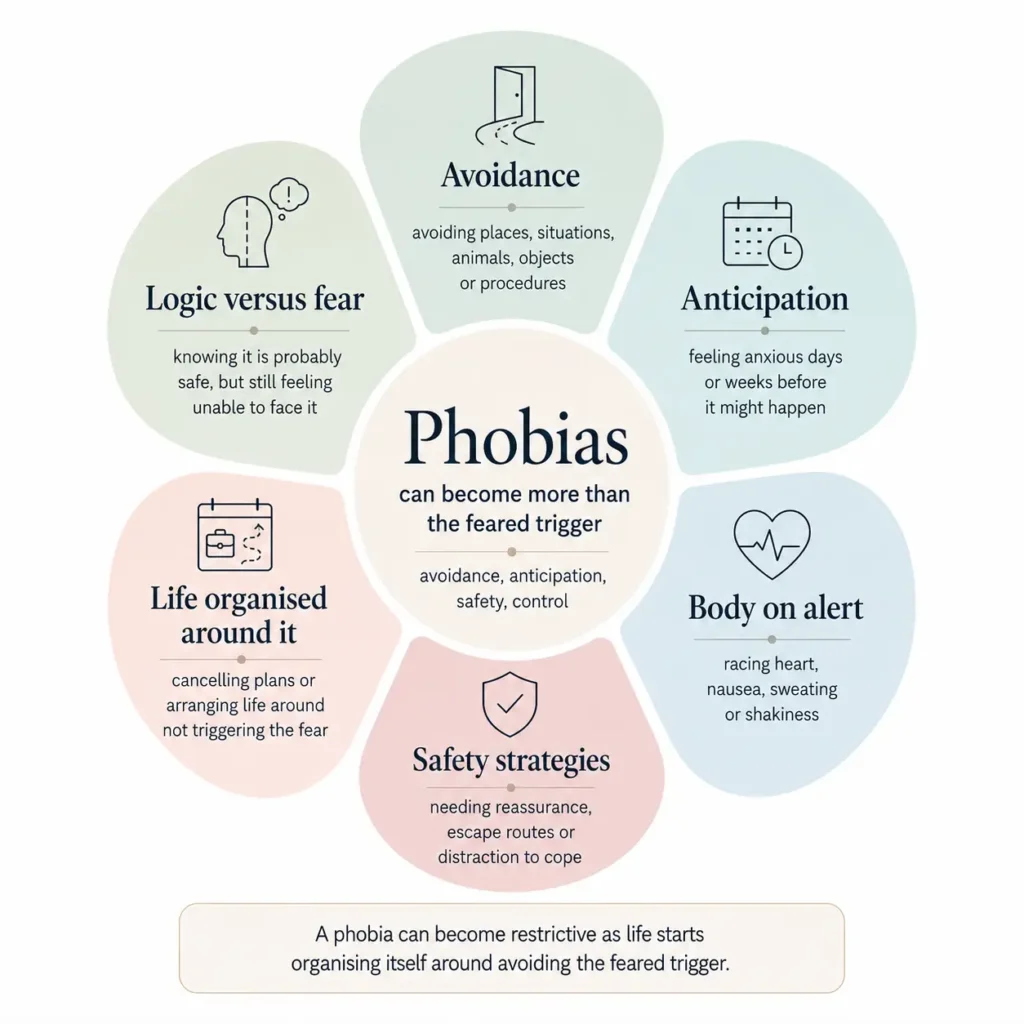
- avoiding specific places, situations, animals, objects, or procedures
- feeling anxious days or weeks before something might happen
- arranging your life around avoiding the feared trigger
- feeling embarrassed because other people seem able to cope easily
- experiencing panic-like symptoms such as a racing heart, nausea, sweating, shakiness, or breathlessness
- needing reassurance, escape routes, medication, alcohol, distraction, or another safety strategy to get through
- cancelling plans, appointments, holidays, or opportunities because of the fear
- feeling trapped between knowing something is probably safe and still being unable to face it
- worrying that you will panic, lose control, faint, vomit, embarrass yourself, or be unable to escape
- feeling frustrated that logic alone has not been enough to change the response
A phobia can become restrictive not only because of the feared object or situation itself, but because of how much life begins to organise itself around avoiding it.
Common Phobias and Intense Fear Responses
This page gives an overview of hypnotherapy for phobias in Manchester. You may also want help with specific phobias and fear responses, including:
- emetophobia and fear of being sick
- driving anxiety and fear of driving
- fear of flying
- needle phobia
- dental phobia
- claustrophobia and fear of confined spaces
- fear of choking
- spiders, animals, and other specific fear responses
- medical procedure anxiety
Some people have one very specific phobia. Others notice that the fear has spread into related situations. For example, fear of being sick may lead to avoidance of restaurants, travel, alcohol, busy places, or contact with unwell people. Fear of flying may become entangled with claustrophobia, panic, loss of control, or fear of heights. Driving anxiety may involve motorways, bridges, unfamiliar routes, being watched by other drivers, or fear after an accident.
The exact trigger matters, but it is not the whole story. Therapy usually becomes more useful when we understand the wider fear pattern: what the mind predicts, how the body responds, what you do to feel safer, and how those responses affect the fear over time.
How Phobias Can Keep Themselves Going
Phobias are often maintained by understandable attempts to avoid danger, panic, illness, embarrassment, or loss of control. If something triggers fear, the mind may predict catastrophe. The body then prepares for threat: heart rate increases, breathing changes, muscles tense, and the urge to escape becomes stronger. These responses can feel convincing, even when the actual level of danger is low.
Avoidance can then bring immediate relief, but short-term relief often teaches the brain that avoidance was necessary. A self-reinforcing pattern can develop: a situation, object, or thought triggers fear; the mind predicts danger, embarrassment, or loss of control; the body becomes activated and prepares to escape; you avoid, check, seek reassurance, or use safety behaviours; relief follows briefly — and each time, the fear pattern becomes a little more believable and more likely to return. Over time, the feared situation can become more loaded and more difficult to approach.
This is why people can understand their phobia intellectually and still feel unable to change it. The issue is not usually a lack of logic. It is a learned fear response that has become strongly associated with avoidance, escape, and short-term relief.
The Role of Safety Behaviours
Safety behaviours are the things people do to feel safer when facing a feared situation. They are often completely understandable, and some may be genuinely useful. Others quietly keep teaching the mind that the feared situation is only manageable if you escape, check, seek reassurance, or stay tightly controlled.
Examples might include:
- only travelling with a trusted person
- always sitting near an exit
- carrying excessive medication or supplies
- checking symptoms repeatedly
- avoiding certain foods, places, routes, or situations
- seeking repeated reassurance
- over-researching the feared situation
- distracting yourself intensely so you do not notice bodily sensations
- leaving as soon as anxiety rises
- postponing appointments or cancelling plans
Safety behaviours can create a hidden message: “I only coped because I had the safety strategy.” This can make it harder to develop confidence that you can handle the situation itself. Therapy may involve looking carefully at which strategies are genuinely helpful, which ones are maintaining the phobia, and how to build a steadier sense of capability over time.
How Hypnotherapy for Phobias Works
Hypnotherapy for phobias is not simply about telling yourself to relax. It is usually more useful when it addresses the whole pattern: the trigger, the bodily alarm response, the feared prediction, the urge to escape, and the safety behaviours that have built up around the avoided situation.
My approach is influenced by Acceptance and Commitment Therapy (ACT), which helps people respond more flexibly to difficult thoughts, feelings, urges, and bodily sensations while taking action guided by what matters to them. You can read more on my Acceptance and Commitment Therapy in Manchester page.
With phobias, this may involve learning to notice thoughts such as “I can’t cope” or “I need to escape” without automatically avoiding, checking, or relying on safety behaviours. The aim is not to wait until fear has completely disappeared. It is to help fear have less control over what you do, what you avoid, and how much of your life becomes organised around the phobia.
Depending on your needs, the work may involve:
- understanding your specific fear pattern — its triggers, predictions, and maintaining responses
- reducing the grip of catastrophic predictions, and relating differently to anxious bodily sensations
- using hypnosis to settle an overactive threat response and rehearse calmer, steadier responses
- reducing reliance on avoidance, reassurance, or safety behaviours, gradually and with your consent
- talking through the feared situation in manageable detail, and noticing the thoughts, images, and sensations that show up
- structured preparation for real-life steps, where appropriate
- building confidence through small, realistic steps, and reconnecting with the life you want beyond the phobia
- small between-session practices, where helpful
ACT gives the work a clear direction: less struggle with fear and bodily alarm, more movement towards the life the phobia has restricted. Hypnosis supports this by helping you mentally rehearse steadier responses to feared situations.
Careful Steps Towards Feared Situations
Where appropriate, the work may include careful, consent-based steps towards feared situations while practising a different response to anxiety, uncertainty, and the urge to escape. This does not mean forcing you to face everything at once, overwhelming you, or treating distress as a test you must pass. The work needs to be planned, realistic, and respectful.
We may also look at what facing the phobia would make possible: health, travel, independence, family life, confidence, career opportunities, or freedom. This helps the work stay connected to something more meaningful than simply “getting through” the fear. In ACT-informed exposure, the aim is not simply to reduce anxiety. It is to practise making room for some discomfort while taking careful steps in the service of freedom, confidence, and choice.
A Brief Example of How the Work May Unfold
Someone might come for help with a fear of flying. On the surface, they may describe the problem as, “I just hate flying.”
When we look more closely, the pattern usually has several parts: fear of being trapped once the plane doors close, worry about panic symptoms happening in public, catastrophic thoughts about turbulence or loss of control, and mental images of something going wrong. This often shows up as avoidance of holidays, work trips, or family visits, repeated reassurance-seeking before travel, and using alcohol, medication, or distraction to get through — often alongside shame or frustration about not being able to cope.
The work would then address the pattern from several angles. We might look at the feared predictions, the body’s alarm response, the urge to escape, and the safety behaviours that seem necessary but may be keeping the fear alive.
Hypnosis may be used to help rehearse a steadier internal response, strengthen a sense of capability, and practise approaching the feared situation from a more grounded position. We would also look at what the person wants the work to make possible: travel, freedom, family connection, career opportunities, or simply no longer organising life around the phobia. The work is not only about reducing fear. It is also about helping the person reclaim movement, choice, and confidence in the situations that matter to them.
When This Approach May Be a Good Fit
This approach may suit you if a phobia is restricting your life and you want therapy to be practical, collaborative, and focused on meaningful change.
You do not need to arrive feeling confident or fully ready to face the fear. Many people seek help precisely because they feel stuck, embarrassed, or unsure where to begin. Part of the work is to understand the pattern clearly and find a way forward that is realistic rather than overwhelming.
What helps is a willingness to look honestly at how the fear operates, try new ways of responding, and, where appropriate, take small, manageable steps outside the session.
This approach may be especially relevant if your phobia is linked with panic, avoidance, self-consciousness, loss of confidence, overthinking, or a sense that life has become narrower around what feels safe.
If you want thoughtful, active support to understand and change a phobic pattern, we can discuss whether this approach seems suitable during the consultation.
When to Seek Additional or Medical Support
Hypnotherapy can be helpful for many phobia and anxiety patterns, but it is not a substitute for urgent or necessary medical care.
If your fear relates to medical treatment, dental treatment, choking, vomiting, allergic reactions, fainting, medication, pregnancy, eating difficulties, or physical symptoms, it may be sensible to speak with your GP, dentist, or another appropriate healthcare professional as part of your wider support.
If your symptoms are severe, have changed suddenly, or you are unsure whether they may have a physical cause, please seek appropriate medical advice. If you feel at risk or need urgent mental health support, use the relevant NHS or emergency services.
We can still discuss whether hypnotherapy may be a useful part of your wider support, but safety and appropriate care come first.
What to Expect Next
The first step is usually a consultation. We can talk through the phobia, how it affects your life, what you currently avoid, what you have already tried, and what you would like to change.
I will ask questions to help us understand the pattern more clearly and explain how I may be able to help. There is no pressure to make a decision on the spot. You are welcome to take time afterwards to decide whether you would like to go ahead.
You can also read more about the wider process on my page about what to expect from hypnotherapy.
Contact me
Please use this form for general enquiries. I will use the details you provide to respond to your enquiry in line with my Privacy Policy. This form is not monitored for urgent or crisis support. If you are in immediate danger, call 999 or go to A&E.
Arrange a Consultation
If you would like to discuss whether phobia therapy or hypnotherapy for phobias may be suitable for you, you are welcome to get in touch and arrange your free 60-minute consultation, held online or at my private Manchester city centre office on Deansgate. I work with phobias and intense fear responses including fear of flying, driving anxiety, needle phobia, emetophobia, claustrophobia, dental phobia, and other specific phobias.
To take the next step, use the contact form or call me on 07790 506375.