
Self-Esteem Therapy in Manchester
Low self-esteem can affect far more than how you feel about yourself. It can shape what you say yes to, what you avoid, how visible you allow yourself to be, and how freely you act in work, relationships, and everyday life.
I’m Adrian Tannock, a CNHC-registered hypnotherapist who runs Lasting Change Hypnotherapy Manchester. Since 2005, I have helped adults with low self-esteem, low confidence, self-doubt, self-consciousness, negative self-talk, poor body image, self-criticism, and related patterns using practical, psychologically informed therapy tailored to the person rather than a one-size-fits-all script.
My aim is not simply to help you feel more positive for a while. It is to help you understand what keeps the self-esteem pattern going and develop steadier, more flexible ways of responding in the situations that matter to you.

CNHC registered · Senior member of the General Hypnotherapy Register · Practising hypnotherapy in Manchester since 2005 · Private office on Deansgate · Registered and insured to practise
Low Self-Esteem, Poor Body Image, and Self-Care
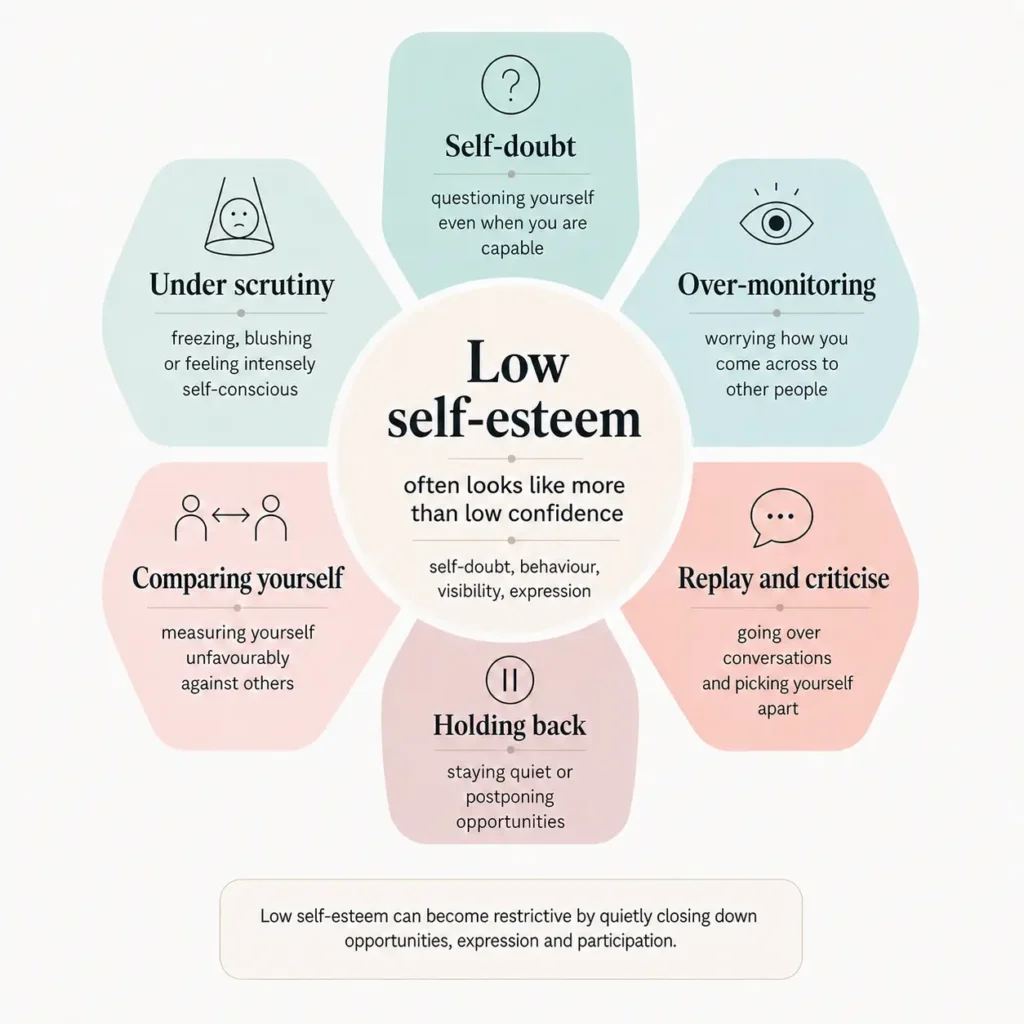
Low self-esteem does not always look like an obvious lack of confidence. Sometimes it shows up as chronic self-questioning, over-preparing, staying quiet when you have something to say, or holding yourself back from opportunities you would genuinely like to take.
It may also affect your relationship with your body, your boundaries, your needs, and your self-care. For some people, low self-esteem becomes tied to poor body image, harsh self-criticism, people-pleasing, avoidance, or the belief that other people’s comfort should always come first.
You may recognise some of the following:
- doubting yourself even when there is evidence that you are capable
- feeling overly concerned with how you come across to other people
- replaying conversations and criticising what you said or did
- avoiding attention, visibility, or situations where you may be judged
- struggling to speak up in meetings, social settings, or relationships
- comparing yourself unfavourably with others
- feeling like an imposter despite outward competence
- postponing decisions or opportunities until you feel more certain
- blushing, freezing, or becoming physically self-conscious under scrutiny
- criticising your appearance, body, needs, or emotions
- finding self-care difficult because you do not feel worth the effort
- feeling frustrated that you understand the problem intellectually but still cannot seem to shift it
Low self-esteem can become restrictive not only because of how it feels, but because of the opportunities, experiences, relationships, and forms of self-expression it gradually closes down.
How Low Self-Esteem Can Keep Itself Going
Low self-esteem is often maintained by the understandable ways people try to protect themselves from embarrassment, criticism, rejection, or failure. You might stay quiet, avoid putting yourself forward, over-prepare before speaking, seek reassurance, compare yourself with others, or wait until you feel fully confident before taking action. These responses can reduce discomfort in the short term, but over time they may strengthen the belief that you are less capable, less acceptable, or less able to cope than other people.
A self-reinforcing pattern can then develop: a situation triggers self-doubt or fear of judgement; the mind predicts embarrassment, rejection, or exposure; you become more self-conscious or physically tense; you hold back, overthink, over-prepare, or seek reassurance; relief follows briefly — and each time, the self-esteem pattern becomes a little more believable and more likely to return.
Over time, life can become organised around minimising risk to self-esteem rather than expressing yourself more fully or moving towards what matters. The issue is not just “not feeling confident”. It is becoming caught up in self-critical thoughts, avoiding situations that expose the self, and waiting to feel acceptable before acting.
How Hypnotherapy for Self-Esteem Works
Hypnotherapy for self-esteem is not simply about installing positive thoughts or making you feel bold on command. The work is usually more useful when it addresses the wider pattern: what triggers self-doubt, how you respond when it appears, and how those responses may be keeping the problem going.
My approach is influenced by Acceptance and Commitment Therapy (ACT), which helps people respond more flexibly to difficult thoughts, feelings, and bodily sensations while taking action guided by what matters to them. You can read more on my Acceptance and Commitment Therapy in Manchester page.
With low self-esteem, this may involve learning to notice thoughts such as “I’m not good enough” or “I need to feel confident first” without automatically holding back, over-preparing, or seeking reassurance. The aim is not to wait until you feel completely confident before life can move forward. It is to help self-doubt have less control over what you say, do, avoid, and allow yourself to try.
Depending on your needs, the work may involve:
- understanding your self-esteem pattern clearly — its triggers, predictions, and self-protective responses
- reducing the grip of harsh self-talk and self-conscious predictions
- using hypnosis to support a steadier, more confident internal response
- developing a more realistic and compassionate inner dialogue
- becoming less dependent on reassurance or external validation
- practical work with avoidance, reassurance-seeking, or excessive self-monitoring
- working with poor body image, self-criticism, or difficulty caring for yourself
- mental rehearsal for situations that currently feel exposing or difficult
- small between-session practices, where helpful
ACT gives the work a clear direction: less struggle with self-critical thoughts and uncomfortable feelings, more movement towards the life you want to participate in. Hypnosis supports this by helping you mentally rehearse steadier responses to situations that currently trigger self-doubt. We may also look at what low self-esteem has been pulling you away from — connection, visibility, work opportunities, self-respect, or fuller participation in life.
For example, we might practise noticing the thought “I’m not good enough” as a thought, making room for some self-doubt, and taking one small step towards speaking up, being seen, or making a choice.
A Brief Example of How the Work May Unfold
Someone might come for help with self-esteem and confidence at work. On the surface, they may describe the problem as, “I know what I’m doing, but I lose confidence when I have to speak up.”
When we look more closely, the pattern usually has several parts: anticipating criticism or being exposed as inadequate, over-preparing before meetings, and staying quiet despite having useful contributions to make. They may monitor colleagues’ expressions for signs of disapproval, then replay the conversation afterwards focusing on perceived mistakes — comparing themselves harshly with more outwardly confident colleagues, and waiting to feel fully ready before taking opportunities that keep passing by.
The work would then address the pattern from several angles. We might look at the self-critical thoughts and threat predictions involved, how the body responds to visibility and evaluation, what avoidance or over-control strategies are doing in the short and long term, and what the person wants greater self-esteem and confidence to make possible in their life.
Hypnosis may be used to help rehearse a steadier internal response, strengthen a more grounded sense of self-trust, and support more flexible engagement with situations that previously triggered self-doubt. The work is not only about feeling more confident. It is also about helping the person act more freely in situations that matter to them.
When This Approach May Be a Good Fit
This approach may suit you if low self-esteem is holding you back and you want therapy to be practical, collaborative, and focused on meaningful change.
You do not need to arrive already feeling clear or confident. Part of the work is to understand how the pattern operates and what it has been preventing you from doing.
What helps is a willingness to look honestly at the ways self-doubt shows up, try new ways of responding, and, where appropriate, bring small parts of the work into everyday life between sessions.
This approach may be especially relevant if low self-esteem is linked with self-criticism, poor body image, avoidance, reassurance-seeking, people-pleasing, low confidence, social anxiety, or difficulty with self-care.
If you want thoughtful, active support to understand and change a low self-esteem pattern that is limiting your life, we can discuss whether this approach seems suitable during the consultation.
When to Seek Additional Support
Hypnotherapy can be helpful for many self-esteem and confidence difficulties, but it is not a substitute for urgent or necessary mental health care.
If low self-esteem is connected with persistent low mood, hopelessness, thoughts of self-harm, or a condition such as depression, body dysmorphia, or an eating disorder, it is sensible to speak with your GP or another appropriate healthcare professional.
If you are struggling to cope, feeling at risk, or need urgent mental health support, you should seek immediate help through the appropriate NHS or emergency services.
We can still discuss whether hypnotherapy may be a useful part of your wider support, but safety and appropriate care come first.
Why Work with Me?
My work is practical, psychologically informed, and tailored to the person rather than delivered from a script. I aim to offer therapy that feels calm, respectful, and clear, while remaining purposeful and connected to the changes you want to make in everyday life.
I have also written a self-help book on confidence and self-esteem, The Confidence Workbook, published in the Teach Yourself range. The book reflects themes I have worked with for many years in practice: self-doubt, negative self-talk, confidence, avoidance, self-belief, and change.
What to Expect Next
The first step is usually a consultation. We can talk through how the self-esteem problem shows up, what it has been affecting, what you would like to change, and whether hypnotherapy seems likely to be a suitable approach.
I will ask questions to help us understand the pattern more clearly and explain how I may be able to help. There is no pressure to make a decision on the spot. You are welcome to take time afterwards to decide whether you would like to go ahead.
You can also read more about the wider process on my page about what to expect from hypnotherapy.
Contact me
Please use this form for general enquiries. I will use the details you provide to respond to your enquiry in line with my Privacy Policy. This form is not monitored for urgent or crisis support. If you are in immediate danger, call 999 or go to A&E.
Arrange a consultation
If you would like to discuss whether self-esteem therapy in Manchester may be suitable for issues around confidence, self-doubt, poor body image, self-criticism, or self-care, you are welcome to get in touch and arrange your free 60-minute consultation, held online or at my private Manchester city centre office on Deansgate.
To take the next step, use the contact form or call me on 07790 506375.