
Habit Reversal Therapy in Manchester
Habits can be frustrating because they often continue even when part of you has clearly decided to stop. You may understand the cost, know what you would prefer to do instead, and still find yourself repeating the same behaviour when stress, boredom, tiredness, tension, or opportunity appears.
Habit change is rarely just a matter of willpower. Many habits become tied into emotional regulation, routines, identity, comfort, relief, reward, self-soothing, or automatic behaviour. The habit may feel irrational afterwards, but in the moment it can seem compelling, familiar, or strangely difficult to interrupt.
I’m Adrian Tannock, a CNHC-registered hypnotherapist who runs Lasting Change Hypnotherapy Manchester. Since 2005, I have helped adults with smoking, nail biting, hair pulling, knuckle cracking, skin picking, and other body-focused repetitive behaviours, as well as procrastination, avoidance, and other self-reinforcing patterns.
I use hypnotherapy alongside Habit Reversal Therapy and ACT-informed methods, tailoring the work to the person and the particular pattern rather than using a one-size-fits-all script.
Habit Reversal Therapy is a practical behavioural approach that helps people become more aware of the urge or routine, identify triggers, and practise alternative responses that interrupt the habit.
The aim is to understand the habit loop, notice the pattern earlier, create workable interruption points, and build more choice in the moments where the behaviour usually takes over.

CNHC registered · Senior member of the General Hypnotherapy Register · Practising hypnotherapy in Manchester since 2005 · Private office on Deansgate · Registered and insured to practise
Urges, Triggers, and Automatic Behaviours
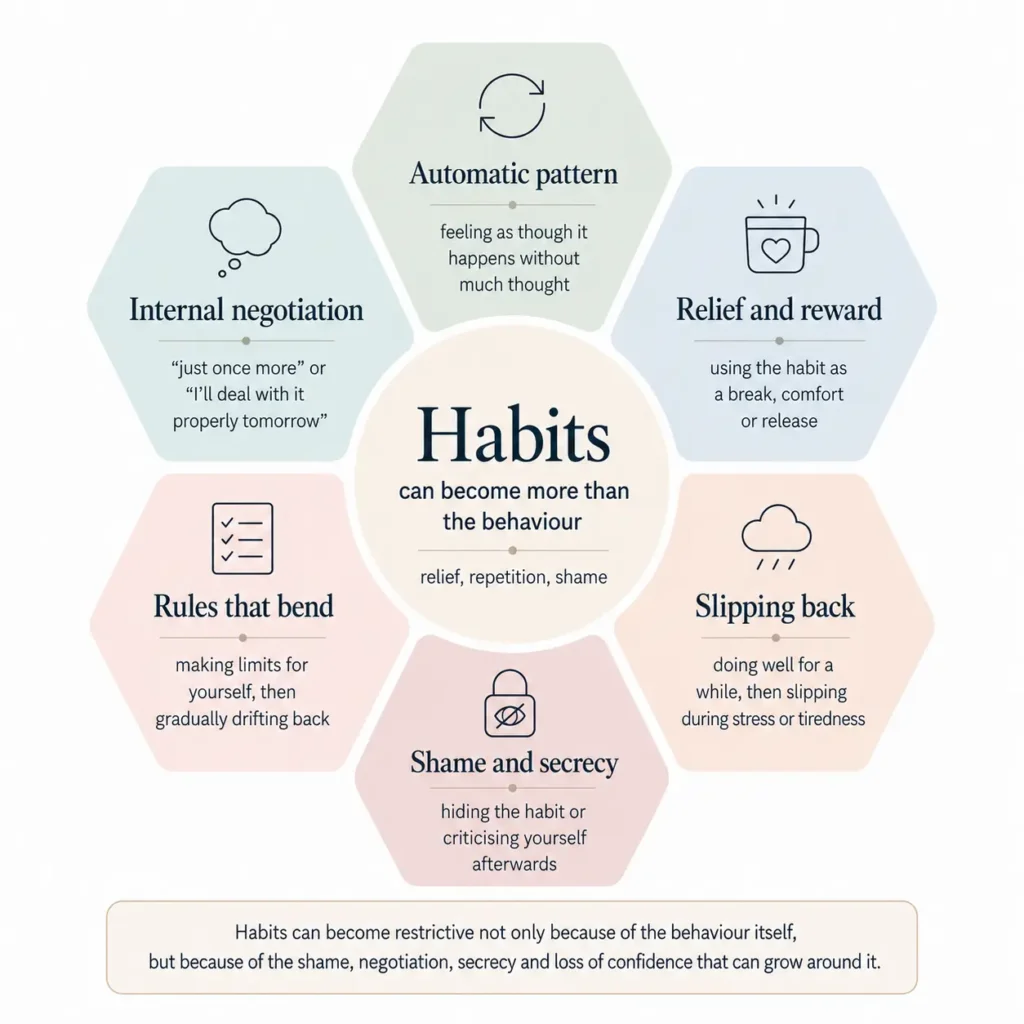
Habits do not always feel like conscious choices. Sometimes they happen before you have fully noticed them. At other times, there is a short internal negotiation: “I’ll stop after this,” “Just once more,” “It doesn’t really matter,” or “I’ll deal with it properly tomorrow.”
You may recognise some of the following:
- repeating a habit even though you have decided to stop
- feeling as though the behaviour happens automatically
- doing well for a while, then slipping back during stress, boredom, or tiredness
- using the habit as a break, reward, comfort, or release
- making rules for yourself, then gradually bending them
- feeling caught between short-term relief and longer-term regret
- hiding the habit from other people or feeling embarrassed by it
- criticising yourself afterwards, then feeling more tense or defeated
- finding that the habit is strongest in certain places, times of day, or emotional states
- worrying that stopping will remove something you rely on
- feeling frustrated because insight alone has not been enough to change the pattern
Habits can become restrictive not only because of the behaviour itself, but because of the shame, negotiation, secrecy, self-criticism, or loss of confidence that can develop around it.
Common Habit Patterns
This page gives an overview of hypnotherapy and habit reversal therapy for habit change in general. You may also want to read more about specific habit patterns, including:
- stop smoking hypnosis
- vaping and nicotine habits
- nail biting
- hair pulling and skin picking
- phone checking, scrolling, and social media habits
- comfort habits linked with stress, avoidance, or emotional regulation
Some habits are mainly behavioural routines. Others are more closely linked with anxiety, self-soothing, body-focused repetition, boredom, perfectionism, emotional overload, or shame. Many people have more than one layer to the pattern.
For example, nail biting may not only be a habit of the hands. It may happen during concentration, driving, television, work pressure, social discomfort, or internal tension. Hair pulling or skin picking may be linked with urges, scanning, trance-like absorption, relief, shame, or attempts to “fix” a sensation or imperfection. Smoking may be tied into stress, breaks, alcohol, identity, transitions, or the feeling of having a moment for yourself.
The specific habit matters, but it is not the whole story. Therapy usually becomes more useful when we understand the wider pattern: the triggers, the urge, the internal negotiation, the emotional payoff, and the situations where the habit has become most automatic.
How Habits Can Keep Themselves Going
Habits are often maintained because they appear to solve something in the short term. A habit might reduce tension, create a pause, offer stimulation, provide comfort, give the hands something to do, mark a transition, or create a brief sense of control. That short-term effect can make the behaviour more likely to happen again.
A self-reinforcing pattern can develop: a situation, feeling, or sensation triggers the habit; the mind predicts relief, comfort, or escape; the urge becomes stronger and harder to ignore; you repeat the behaviour, or tell yourself it will be the last time; relief or satisfaction follows briefly — and each time, the association between the habit and relief becomes a little stronger.
Over time, the behaviour can become less like a deliberate choice and more like a well-worn route. The habit may appear before you have had time to think, especially when you are tired, stressed, distracted, or emotionally overloaded.
This is why many people find it unhelpful when others say, “Just stop doing it.” If it were that simple, they probably would have stopped already. The more useful question is: what is the habit doing for you in the short term, and how can we help you respond differently without relying on that old pattern?
The Role of Urges, Routines, and Identity
Habits often sit at the meeting point between urge, routine, and identity.
The urge is the immediate pull: the craving, tension, itch, restlessness, impulse, or sense that something needs to happen. The routine is the familiar sequence: when it happens, where it happens, what usually comes before it, and what follows afterwards. The identity piece is the story that develops around it: “I’m just someone who does this,” “I have no discipline,” “I always go back to it,” or “This is how I cope.”
Therapy may involve working with all three. We may look at how to notice the urge, pause before acting, interrupt familiar routines, and step back from the self-critical stories that make change feel harder. This does not mean pretending the habit is harmless or avoiding responsibility. It means creating the conditions where responsibility becomes more workable.
For example, we might look at what tends to trigger the habit, what relief it provides, what your hands or body do automatically, and what alternative response could be practised at that point.
Shame and Self-Criticism Can Keep Habits Alive
Many people try to change habits by attacking themselves. They tell themselves they are weak, disgusting, lazy, childish, undisciplined, or broken. This may create pressure, but it rarely creates lasting change. More often, it increases stress, and stress then becomes another trigger for the habit.
Shame and self-criticism often make habits harder to change, so the work is firm and practical without treating the habit as a personal failing. A more effective approach is usually clear, honest, and compassionate — taking the habit seriously without turning it into evidence that there is something fundamentally wrong with you. We can understand the pattern without excusing it, and work on change without using shame as the main fuel.
How Hypnotherapy, Habit Reversal Therapy, and ACT May Help
Hypnotherapy for habit change is not simply about installing a command to stop. The work is usually more useful when it addresses the wider pattern: what triggers the habit, what the habit seems to provide, what happens in your mind and body beforehand, and how you can begin to respond differently.
Habit Reversal Therapy, also known as Habit Reversal Training, can be especially useful when a habit has become automatic or body-focused. This may include patterns such as nail biting, hair pulling, skin picking, touching, checking, picking at imperfections, or other repeated behaviours that happen during stress, concentration, boredom, or tension.
Acceptance and Commitment Therapy (ACT) helps people respond more flexibly to difficult thoughts, feelings, urges, and bodily sensations, so behaviour is guided less by short-term relief and more by what matters. You can read more on my Acceptance and Commitment Therapy in Manchester page.
Habit reversal can help with the practical interruption of the habit. ACT can help with the discomfort, frustration, urges, or self-critical thoughts that often appear when you try not to do the familiar behaviour. In practice, this means the aim is not always to wait until the urge disappears before you act differently. It is to help you notice the pull of the habit, make room for discomfort where necessary, and choose a response that fits the life you want rather than the short-term relief the habit promises.
Depending on your needs, the work may involve:
- understanding the specific habit loop you are caught in — its triggers, routines, and high-risk situations
- noticing the earliest signs of the urge or automatic movement
- developing alternative or competing responses that are realistic for you
- reducing the grip of thoughts such as “Just once” or “I’ll stop later”
- using hypnosis to support calmer, more resourceful responding, and mental rehearsal for interrupting the habit
- helping you relate differently to self-critical thoughts and internal negotiations
- reconnecting with the kind of person you want to be beyond the habit
- preparing for predictable high-risk situations and for setbacks, without turning them into full relapse
- small between-session practices, where helpful
The exact balance will vary. The aim is to understand the habit clearly and use the most relevant methods to help you respond with greater steadiness, flexibility, and self-trust.
A Brief Example of How the Work May Unfold
Someone might come for help with compulsively checking their phone throughout the day. On the surface, they may describe the problem as, “I know it’s a waste of time, but I pick it up without even deciding to.”
When we look more closely, the pattern usually has several parts: reaching for the phone during any pause, boredom, or moment of discomfort, unlocking it automatically, and scrolling well past whatever the original reason was. There’s a brief hit of stimulation or relief, but time gets lost in the process, and afterwards comes frustration or guilt about how long it took — followed by the same reach for the phone at the next natural gap in the day.
The work would then address the pattern from several angles. We might look at the situations most likely to trigger picking up the phone, the restlessness or boredom that builds beforehand, the thoughts that give permission (“just for a second”), and the emotional effect that follows.
Hypnosis may be used to rehearse noticing the urge earlier, pausing before picking up the phone, and responding differently to boredom or restlessness. We may also work on practical changes around triggers — where the phone is kept, which notifications are on, replacement behaviours, and recovering quickly from slips rather than treating one lapse as failure. The work is not only about reducing screen time. It is also about helping the person build a different relationship with boredom, stimulation, and impulse.
When This Approach May Be a Good Fit
This approach may suit you if a habit is limiting your life, affecting your confidence, damaging your health or appearance, or leaving you feeling stuck in a cycle of intention, repetition, and regret.
You do not need to arrive feeling fully confident that you can change. Many people seek help precisely because they have tried to stop before and found the pattern stronger than expected. Part of the work is to understand why previous attempts have not held and what needs to be different this time.
What helps is a willingness to look honestly at the habit, prepare for familiar triggers, practise different responses, and engage with the process rather than hoping hypnosis will simply remove the problem without your participation.
If you want thoughtful, active support to understand and change a habit pattern, we can discuss whether this approach seems suitable during the consultation.
When to Seek Additional or Medical Support
Hypnotherapy can be a useful form of support for habit change, but it is not a substitute for urgent or necessary medical or mental health care.
If a habit involves injury, infection, significant hair loss, skin damage, bleeding, severe distress, disordered eating, substance dependence, self-harm, or symptoms that may need medical assessment, it is sensible to speak with your GP or another appropriate healthcare professional.
If you are dealing with a diagnosed mental health condition, severe anxiety, depression, obsessive-compulsive symptoms, or trauma-related difficulties, hypnotherapy may still be worth discussing, but it should sit within appropriate care and support.
We can still discuss whether hypnotherapy or habit reversal therapy may be a useful part of your wider support, but safety and appropriate care come first.
What to Expect Next
The first step is usually a consultation. We can talk through the habit, how long it has been present, what tends to trigger it, what you have already tried, and what you would like to change.
I will ask questions to help us understand the pattern more clearly and explain how I may be able to help. There is no pressure to make a decision on the spot. You are welcome to take time afterwards to decide whether you would like to go ahead.
You can also read more about the wider process on my page about what to expect from hypnotherapy.
Contact me
Please use this form for general enquiries. I will use the details you provide to respond to your enquiry in line with my Privacy Policy. This form is not monitored for urgent or crisis support. If you are in immediate danger, call 999 or go to A&E.
Arrange a Consultation
If you would like to discuss whether habit reversal therapy in Manchester may be suitable for unwanted habits, compulsive habits, nail biting, hair pulling, skin picking, or other body-focused repetitive behaviours, you are welcome to get in touch and arrange your free 60-minute consultation, held online or at my private Manchester city centre office on Deansgate.
To take the next step, use the contact form or call me on 07790 506375.