
Stop Smoking Hypnosis in Manchester
Stopping smoking is rarely just a matter of knowing it is bad for you. Most smokers already know the risks. The harder part is dealing with the habit, the urges, the routines, the emotional associations, and the part of the mind that still treats smoking as a reward, a break, a comfort, or a form of control.
I’m Adrian Tannock, a CNHC-registered hypnotherapist based in Manchester city centre. Since 2005, I have helped adults with smoking, habits, urges, avoidance patterns, and self-sabotage using practical, psychologically informed stop smoking hypnosis tailored to the person rather than a one-size-fits-all script.
My aim is not simply to make smoking seem unpleasant for a while. It is to help you understand the pattern that keeps it in place, strengthen your commitment to stopping, and develop a steadier way of responding when urges, triggers, or old routines appear.

CNHC registered · Senior member of the General Hypnotherapy Register · Practising hypnotherapy in Manchester since 2005 · Private office on Deansgate · Registered and insured to practise
Urges, Routines, and the Smoking Habit Loop
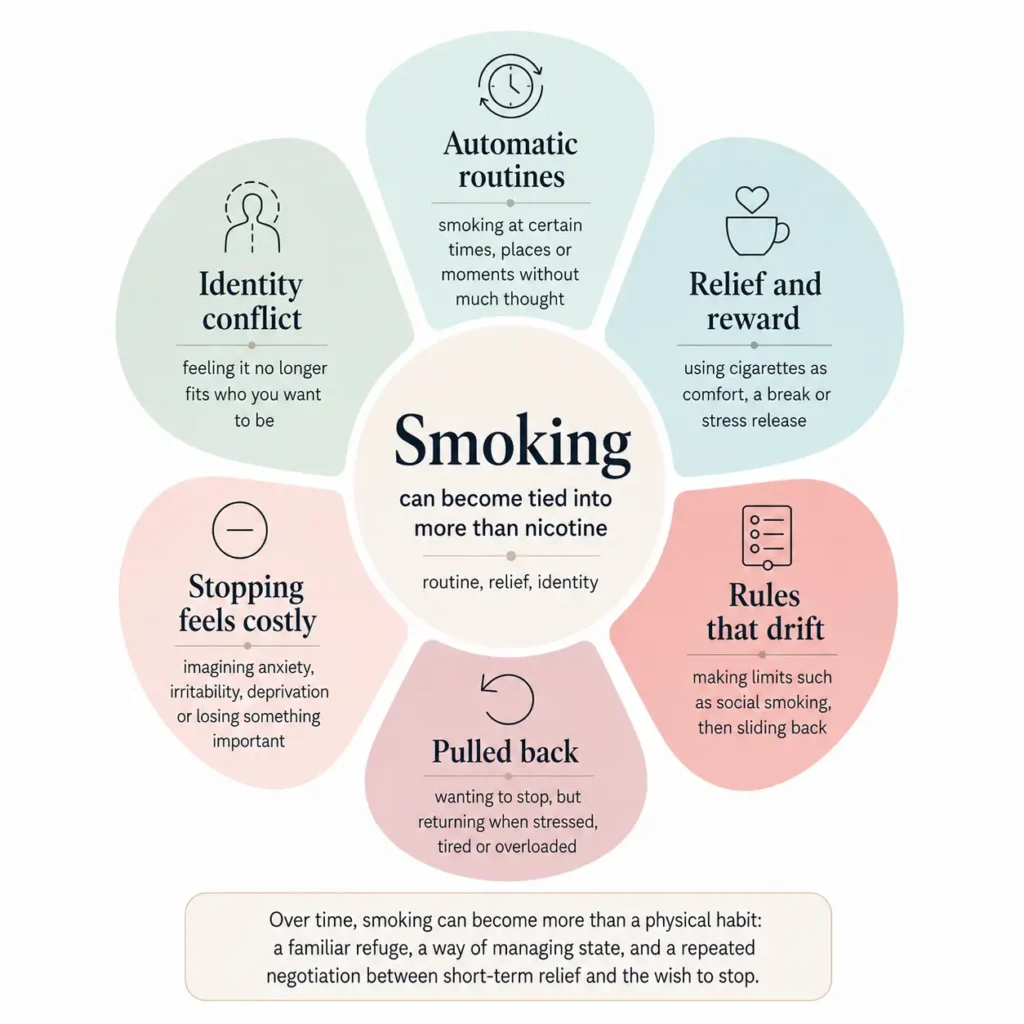
Smoking often becomes woven into daily routines, emotional states, and identity. It may be linked with stress, boredom, work breaks, driving, alcohol, social situations, after meals, or the feeling of taking a moment for yourself.
You may recognise some of the following:
- wanting to stop but repeatedly returning to smoking
- using cigarettes as a break, reward, comfort, or stress release
- smoking automatically at certain times of day
- feeling anxious, irritable, or deprived when you imagine stopping
- making rules such as “only socially” or “only when stressed”, then drifting back
- feeling frustrated because you know the reasons to stop but still feel pulled back
- smoking more when drinking, stressed, tired, or emotionally overloaded
- worrying that stopping will remove something you rely on
- feeling that smoking no longer fits who you want to be, but still struggling to let it go
Over time, smoking can become more than a physical habit. It can become a familiar refuge, a way of managing your state, and a repeated negotiation between the part of you that wants to stop and the part that wants short-term relief.
Why Smoking Can Feel So Hard to Stop
Smoking often continues because it appears to solve something in the short term. It may seem to reduce stress, create a pause, mark a transition, punctuate the day, or offer a quick sense of relief when you feel tense, bored, restless, or overloaded.
A self-reinforcing pattern can then develop: a situation, feeling, or routine triggers the urge to smoke; the mind predicts relief, comfort, or escape; the urge becomes stronger and harder to ignore; you smoke, or tell yourself you will stop later; relief follows briefly — and each time, the association between smoking and relief becomes a little stronger.
Over time, the habit can become less like a free choice and more like something that happens automatically, especially at certain times, in certain places, or when particular feelings show up. The issue is not simply a lack of willpower. It is a learned habit loop involving urge, relief, reward, repetition, and emotional regulation.
How Stop Smoking Hypnosis Works
Stop smoking hypnotherapy is not simply about willpower or being told that cigarettes are bad for you. The work is usually more useful when it addresses the wider pattern: the routines, triggers, beliefs, urges, and emotional associations that keep smoking in place.
My approach is influenced by Acceptance and Commitment Therapy (ACT), which helps people respond more flexibly to difficult thoughts, feelings, and bodily sensations while taking action guided by what matters to them. You can read more on my Acceptance and Commitment Therapy in Manchester page.
With smoking, this may involve learning to notice urges and thoughts such as “just one” or “I need this to cope” without automatically acting on them. The aim is not to rely on every craving disappearing. It is to help your decision to stop carry more weight than the short-term pull of relief, habit, or reward.
Depending on your needs, the work may involve:
- understanding your smoking pattern clearly — its triggers, routines, and high-risk situations
- clarifying your reasons for stopping, and strengthening your commitment to becoming smoke-free
- changing the emotional meaning of cigarettes
- using hypnosis to support the transition towards seeing yourself and acting as someone who no longer smokes
- responding differently to urges, cravings, and old routines, such as “just one” or “I’ll stop later”
- mental rehearsal for handling stress, alcohol, boredom, or social pressure without smoking
- looking at what stopping represents for you: health, freedom, self-respect, family, fitness, or money
- between-session reflections, preparations, or practical changes, where helpful
ACT gives the work a clear direction: less struggle with urges, more movement towards the life and identity you want as a non-smoker. Hypnosis supports this by helping you mentally rehearse new responses to familiar triggers. For example, we might practise noticing the thought “I deserve one” as a thought, allowing the craving to rise and fall, and choosing a response that fits your decision to stop.
A Brief Example of How the Work May Unfold
Someone might come for help because they have smoked for years and feel increasingly ready to stop, but keep returning to the habit during stress, drinking, or moments of boredom. On the surface, they may describe the problem as, “I know I need to stop, but part of me still wants it.”
When we look more closely, the pattern usually has several parts: cigarettes associated with relief or time out, automatic smoking at certain points in the day, and stronger urges around alcohol or stress. Thoughts such as “I deserve one” or “I’ll stop properly next week” tend to appear, often alongside a fear that stopping will leave a gap, and frustration or shame left over from previous attempts — even as a growing sense builds that smoking no longer fits who they want to be.
The work would then address the pattern from several angles. We might clarify your reasons for stopping, look at the situations where smoking still seems to offer something, prepare for likely triggers, and strengthen your commitment to acting as someone who no longer smokes, even when the old pull appears.
Hypnosis may be used to rehearse responding differently to urges, stepping out of automatic routines, and connecting more strongly with who you want to be and what stopping would make possible. The work is not only about resisting cigarettes. It is also about helping you build a different relationship with urges, routines, and the decision you have made to stop.
When This Approach May Be a Good Fit
This approach may suit you if you are ready to stop smoking and want support that is practical, focused, and adapted to the way the habit works for you.
You do not need to arrive feeling completely confident. Many people feel conflicted before stopping: part of them wants to be free of smoking, while another part still associates cigarettes with relief, reward, identity, or control. Part of the work is to understand that conflict and strengthen your ability to act in line with your decision to stop.
What helps is a willingness to look honestly at the habit, prepare for familiar triggers, and engage with the process rather than hoping hypnosis will simply remove the issue without your participation.
If you are mainly looking to be “made” to stop while remaining ambivalent about stopping, this may not be the best fit. If you are ready to take stopping seriously and want thoughtful, active support with the pattern, we can discuss whether this approach seems suitable during the consultation.
Stop Vaping Hypnotherapy
Some people also seek help with vaping, especially when vaping has become automatic, frequent, or difficult to reduce.
Vaping can have its own habit loop: urges, hand-to-mouth behaviour, routines, stress relief, boredom, and the feeling of “just a few puffs”. The work would still focus on understanding the pattern clearly, preparing for triggers, responding differently to urges, and supporting the transition towards no longer relying on nicotine as a coping strategy.
Medical Support and Stopping Smoking
Hypnotherapy can be a useful form of support for stopping smoking, but it does not replace medical advice or NHS stop smoking services.
For some people, combining psychological support with NHS stop smoking services, nicotine replacement, or medical advice may be useful. If you are using nicotine replacement, prescribed medication, or have health concerns related to smoking or stopping, it is sensible to speak with your GP, pharmacist, or another appropriate healthcare professional.
We can still discuss whether hypnotherapy may be a useful part of your wider stop smoking plan, but safety and appropriate care come first.
What to Expect Next
The first step is usually a consultation. We can talk through your smoking pattern, how long it has been part of your life, what you have already tried, what tends to trigger smoking, and how ready you feel to stop.
I will ask questions to help us understand the habit more clearly and explain how I may be able to help. I want clients to understand what we are doing, why we are doing it, and how it relates to the wider smoking pattern they are trying to change.
There is no pressure to make a decision on the spot. You are welcome to take time afterwards to decide whether you would like to go ahead.
You can also read more about the wider process on my page about what to expect from hypnotherapy.
Contact me
Please use this form for general enquiries. I will use the details you provide to respond to your enquiry in line with my Privacy Policy. This form is not monitored for urgent or crisis support. If you are in immediate danger, call 999 or go to A&E.
Arrange a consultation
If you would like to discuss whether stop smoking hypnosis in Manchester may be suitable for you, you are welcome to get in touch and arrange your free 60-minute consultation, held online or at my private Manchester city centre office on Deansgate. I work with smoking habits, urges, cravings, automatic routines, social smoking, and vaping patterns.
To take the next step, use the contact form or call me on 07790 506375.