
Procrastination Therapy in Manchester
Procrastination is rarely just laziness. Many people who procrastinate are capable, thoughtful, and genuinely motivated, but still find themselves delaying important tasks, avoiding decisions, leaving things until the last minute, or feeling trapped between intention and action.
I’m Adrian Tannock, a CNHC-registered hypnotherapist who runs Lasting Change Hypnotherapy Manchester. Since 2005, I have helped adults with procrastination, avoidance, low motivation, perfectionism, self-doubt, anxiety, and related patterns using practical, psychologically informed therapy tailored to the person rather than a one-size-fits-all script.
My aim is not simply to help you “try harder”. It is to help you understand what keeps the procrastination pattern going and develop steadier, more workable ways of taking action in everyday life.

CNHC registered · Senior member of the General Hypnotherapy Register · Practising hypnotherapy in Manchester since 2005 · Private office on Deansgate · Registered and insured to practise
Avoidance, Overwhelm, and Follow-Through
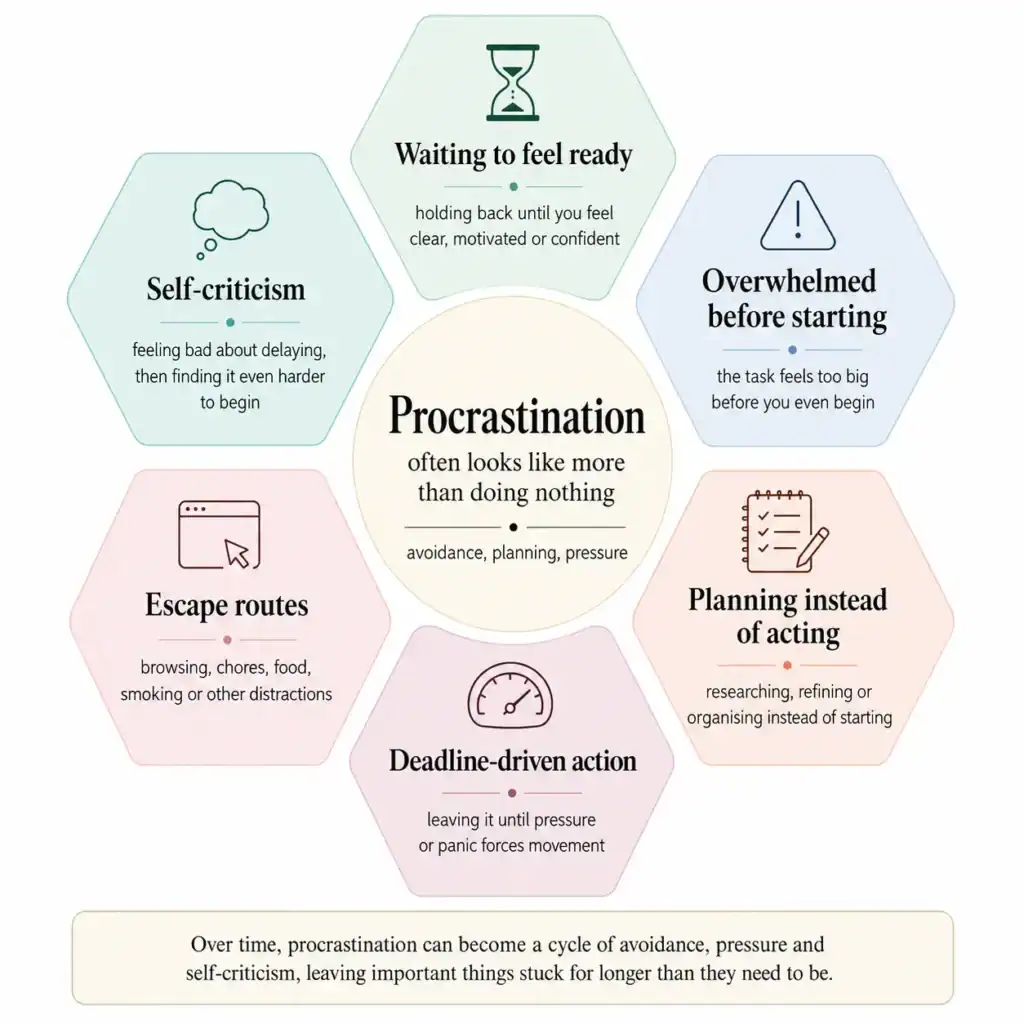
Procrastination does not always look like doing nothing. Sometimes it looks like thinking, planning, researching, waiting for the right mood, reorganising your workspace, or doing lower-priority tasks while the important thing remains untouched.
You may recognise some of the following:
- putting off tasks even when you know they matter
- waiting until you feel ready, confident, motivated, or clear
- feeling overwhelmed before you even begin
- avoiding tasks that involve uncertainty, judgement, or possible failure
- starting things but struggling to finish them
- spending too long planning, researching, or refining instead of acting
- leaving things until pressure, panic, or a deadline forces action
- criticising yourself for procrastinating, then feeling even less able to start
- using distractions, browsing, food, alcohol, smoking, or chores as escape routes
- feeling frustrated because you understand the problem intellectually but still repeat the same pattern
Procrastination can become exhausting because it creates a constant background sense of unfinished business. Even when you are not working on the task, part of your mind may still be carrying it.
How Procrastination Reinforces Itself
Procrastination is often maintained by the understandable things people do to escape discomfort. A task may trigger uncertainty, boredom, frustration, fear of criticism, fear of failure, or a sense of not knowing where to start. Avoiding the task can then bring immediate relief, but this short-term relief often strengthens the longer-term pattern.
A self-reinforcing cycle can develop: a task, decision, or responsibility triggers discomfort; the mind predicts difficulty, failure, or overwhelm; the body becomes tense, heavy, or restless; you delay, distract, overthink, or switch to something easier; relief follows briefly — and each time, the task becomes more loaded, more urgent, and harder to approach next time.
Over time, procrastination can damage confidence. You may begin to see yourself as lazy, weak, unreliable, or undisciplined, even when the deeper pattern is more about avoidance, threat, emotional regulation, perfectionism, or difficulty tolerating discomfort. The problem is not usually a lack of intelligence or insight. It is becoming caught in a loop where avoidance brings short-term relief but makes follow-through harder over time.
How Hypnotherapy for Procrastination Works
Hypnotherapy for procrastination is not simply about forcing motivation or installing a more disciplined personality. The work is usually more useful when it addresses the wider pattern: what triggers avoidance, what happens in your thoughts and body, what short-term relief you get from delaying, and what the pattern costs you over time.
My approach is influenced by Acceptance and Commitment Therapy (ACT), which helps people respond more flexibly to difficult thoughts, feelings, and bodily sensations while taking action guided by what matters to them. You can read more on my Acceptance and Commitment Therapy in Manchester page.
With procrastination, this may involve learning to notice thoughts such as “I’ll do it later” or “this has to be perfect” without automatically delaying, distracting, or retreating. The aim is not to wait until resistance, doubt, or discomfort has disappeared. It is to help you take workable steps even when part of you wants to avoid, postpone, or retreat.
Depending on your needs, the work may involve:
- understanding the specific procrastination loop you are caught in, and its triggers and maintaining responses
- reducing the grip of self-critical thoughts and threat predictions
- using hypnosis to support a calmer and more resourceful internal state
- responding differently to overwhelm, uncertainty, or boredom
- working with perfectionism and fear of not doing something well enough
- building greater tolerance for the discomfort of starting
- mental rehearsal for starting, continuing, and completing tasks
- strengthening follow-through and self-trust, and developing a more compassionate response to setbacks
- small between-session practices, where helpful
ACT gives the work a clear direction: less struggle with discomfort, doubt, and self-criticism, more movement towards what matters. Hypnosis supports this by helping you mentally rehearse starting, continuing, and returning to tasks more steadily. We may also look at what the task is connected to — work, health, independence, creativity, self-respect, or peace of mind — so action is not driven only by panic, guilt, or deadlines.
For example, we might practise noticing the thought “I need to feel ready first” as a thought, making room for the discomfort of starting, and taking one small step before motivation has arrived.
A Brief Example of How the Work May Unfold
Someone might come for help because they repeatedly delay important work. On the surface, they may describe the problem as, “I just can’t make myself do it.”
When we look more closely, the pattern usually has several parts: the task feels too large, unclear, or emotionally loaded, and starting brings up pressure or fear of doing it badly. The person waits until they feel more motivated or certain, then distracts themselves with something easier. Temporary relief follows, but guilt and self-criticism build afterwards, and the next attempt to start feels even more difficult.
The work would then address the pattern from several angles. We might look at how the person responds to discomfort, what perfectionism or self-criticism contributes, how avoidance brings short-term relief, and what they want to be able to do differently in real life.
Hypnosis may be used to help rehearse starting more calmly, staying with discomfort without being dominated by it, and acting from a steadier sense of purpose rather than pressure or panic. The work is not only about getting more done. It is also about helping the person build a different relationship with effort, discomfort, responsibility, and follow-through.
When This Approach May Be a Good Fit
This approach may suit you if procrastination is limiting your life and you want therapy to be practical, collaborative, and focused on meaningful change.
You do not need to arrive already motivated, organised, or clear. Part of the work is to understand why action has become difficult and what has been keeping the pattern in place. What helps is a willingness to look honestly at how procrastination operates, try new ways of responding, and, where appropriate, bring small parts of the work into everyday life between sessions.
This approach may be especially relevant if procrastination is linked with anxiety, perfectionism, self-doubt, overwhelm, avoidance, low confidence, ADHD-related difficulties, or difficulty tolerating frustration.
If you want thoughtful, active support to understand and change a procrastination pattern, we can discuss whether this approach seems suitable during the consultation.
When to Seek Additional Support
Procrastination can sometimes overlap with anxiety, depression, ADHD, burnout, trauma responses, sleep problems, or other difficulties. Hypnotherapy and ACT-informed work can be helpful for many patterns, but they are not a substitute for medical or mental health care where that is needed.
If your difficulties are severe, have changed suddenly, or you are concerned about your mood, concentration, health, or ability to cope, it is sensible to speak with your GP or another appropriate healthcare professional.
If you are struggling to cope, feeling at risk, or need urgent mental health support, you should seek immediate help through the appropriate NHS or emergency services.
We can still discuss whether hypnotherapy may be a useful part of your wider support, but safety and appropriate care come first.
What to Expect Next
The first step is usually a consultation. We can talk through how procrastination shows up, what it has been affecting, what you have already tried, and what you would like to change.
I will ask questions to help us understand the pattern more clearly and explain how I may be able to help. There is no pressure to make a decision on the spot. You are welcome to take time afterwards to decide whether you would like to go ahead.
You can also read more about the wider process on my page about what to expect from hypnotherapy.
Contact me
Please use this form for general enquiries. I will use the details you provide to respond to your enquiry in line with my Privacy Policy. This form is not monitored for urgent or crisis support. If you are in immediate danger, call 999 or go to A&E.
Arrange a Consultation
If you would like to discuss whether hypnotherapy for procrastination in Manchester may be suitable for you, you are welcome to get in touch and arrange your free 60-minute consultation, held online or at my private Manchester city centre office on Deansgate.
To take the next step, use the contact form or call me on 07790 506375.