Driving Test Anxiety and Exam Nerves in Manchester
Driving test anxiety and exam nerves can make important moments feel far harder than they need to be. You may know the material, have practised the skills, or be capable of passing, but still find that pressure, fear of failing, bodily anxiety, or the fear of going blank interferes when it matters.
For some people, anxiety appears before academic exams, interviews, practical assessments, or professional tests. For others, it centres on the driving test: being watched by the examiner, making a mistake, stalling, hesitating, panicking, or feeling that one error will ruin everything.
I’m Adrian Tannock, a CNHC-registered hypnotherapist based in Manchester city centre. Since 2005, I have helped adults with anxiety, performance pressure, fear of failure, low confidence, panic, avoidance, and related patterns using practical, psychologically informed hypnotherapy tailored to the person rather than a one-size-fits-all script.
My aim is not to promise a particular result or replace study, practice, or driving instruction. It is to help you understand the anxiety pattern, respond more flexibly under pressure, and approach tests with more steadiness, clarity, and confidence.

CNHC registered · Senior member of the General Hypnotherapy Register · Practising hypnotherapy in Manchester since 2005 · Private office on Deansgate · Registered and insured to practise
Tests, Performance Pressure, and Fear of Going Blank
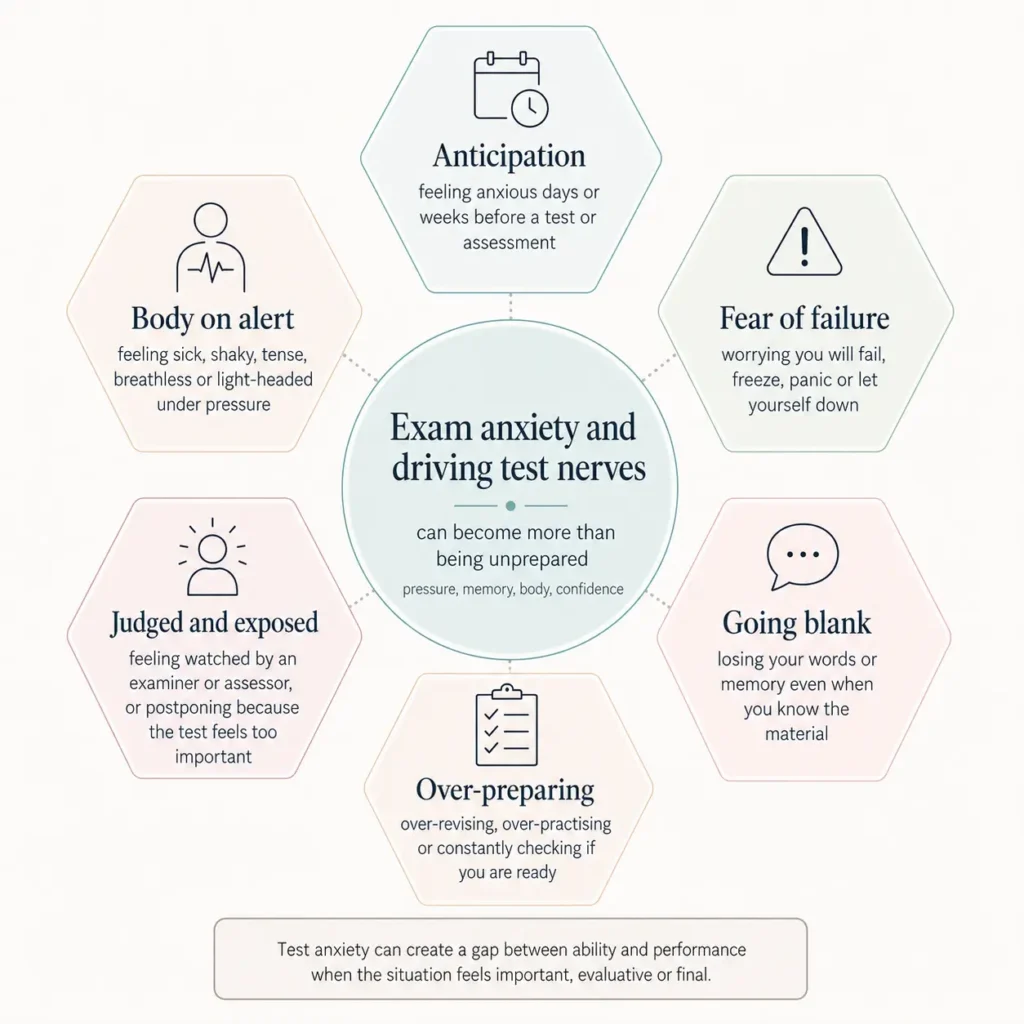
Exam anxiety and driving test nerves do not always mean you are unprepared. Often, the problem is the way pressure affects attention, memory, body sensations, and confidence.
You may recognise some of the following:
- feeling anxious days or weeks before an exam, test, or assessment
- worrying that you will fail, freeze, panic, or let yourself down
- going blank even when you know the material
- over-revising, over-practising, or constantly checking whether you are ready
- struggling to sleep before a test
- feeling sick, shaky, tense, breathless, or light-headed under pressure
- replaying previous mistakes or failed attempts
- feeling watched, judged, or exposed during a driving test
- becoming tense when an examiner, teacher, or assessor is present
- avoiding booking the test or repeatedly postponing it
- feeling that one mistake means everything has gone wrong
- losing confidence because anxiety has affected performance before
Test anxiety can become frustrating because it often creates a gap between ability and performance. You may be capable in practice, but struggle when the situation feels important, evaluative, or final.
How Exam Nerves and Driving Test Anxiety Can Keep Themselves Going
Test anxiety is often maintained by a cycle of pressure, threat prediction, body alarm, and self-protection. A test begins to feel important. The mind predicts failure, embarrassment, or loss of control. The body responds as though there is danger. Attention narrows, memory can feel harder to access, and ordinary mistakes feel more significant.
A self-reinforcing pattern can develop: an exam, test, or assessment triggers anxiety; the mind predicts failure, blankness, or humiliation; the body becomes tense and alert; attention shifts towards symptoms, mistakes, or imagined consequences; you overthink, rush, freeze, or over-prepare; relief follows briefly when the pressure passes — and each time, the fear of future tests becomes a little more believable.
Over time, the test can start to feel like a threat rather than an opportunity to demonstrate what you know or what you can do. The issue is not usually a lack of ability. It is often a learned performance anxiety pattern involving pressure, fear of failure, bodily symptoms, attention, and avoidance.
Fear of Going Blank
Many people seek help because they fear going blank. This can happen in written exams, oral exams, interviews, presentations, theory tests, practical tests, or driving tests. The fear itself can become part of the problem. You start monitoring whether your mind is working properly, which increases pressure and makes clear thinking harder.
You might think:
- “What if I forget everything?”
- “What if my mind goes blank?”
- “What if I panic?”
- “What if I make a stupid mistake?”
- “What if everyone realises I can’t do this?”
The work is not simply about trying to force calm. It is about helping you respond differently to pressure, uncertainty, and anxious thoughts, so your attention can return to the task in front of you.
How Hypnotherapy May Help with Exam Nerves and Driving Test Anxiety
Hypnotherapy for exam nerves and driving test anxiety is not simply about relaxation. Relaxation can be useful, but the work usually needs to address the wider pattern: what triggers the anxiety, what the mind predicts, what happens in the body, and how pressure affects behaviour.
My approach is influenced by Acceptance and Commitment Therapy (ACT), which helps people respond more flexibly to difficult thoughts, feelings, and bodily sensations while taking action guided by what matters to them. You can read more on my Acceptance and Commitment Therapy in Manchester page.
With exam nerves or driving test anxiety, this might mean noticing thoughts such as “I’m going to fail” or “I’ll go blank” without automatically rushing, freezing, or trying to control every sensation. The aim is not to make every anxious thought or feeling disappear before you can perform. It is to help you relate differently to anxiety, return attention to the task in front of you, and take the next useful step.
Depending on your needs, the work may involve:
- understanding your test anxiety pattern clearly — its triggers, predictions, and maintaining responses
- reducing the grip of fear of failing or going blank
- using hypnosis to develop steadier ways to respond when the body’s threat response shows up
- practising how to return attention to the task when anxiety pulls it away
- reducing avoidance, over-preparation, or reassurance-seeking
- mental rehearsal for exams, driving tests, interviews, or assessments
- building realistic confidence through preparation, rehearsal, and values-guided action
- small between-session practices, where helpful
For example, we might practise noticing the thought “I’m going to mess this up” as a thought, making room for some anxiety, and bringing attention back to the question, the road, the instruction, or the next useful action.
Driving Test Anxiety
Driving test anxiety can be especially difficult because the test combines performance pressure, safety, observation, and the need to respond in real time.
You may feel calm enough in lessons, but anxious when you imagine the examiner sitting beside you. You may worry about stalling, hesitating at junctions, making a serious fault, forgetting a manoeuvre, becoming shaky, or losing concentration because you are being assessed.
The work may involve:
- understanding what specifically triggers driving test nerves
- mentally rehearsing the test day more steadily
- responding differently to the examiner’s presence
- recovering from small mistakes without spiralling
- reducing fear of being watched or judged
- returning attention to the road, the instruction, and the next useful action
- strengthening realistic confidence in your preparation and decision-making
Hypnotherapy does not replace driving lessons, practice, or professional driving instruction. If you are preparing for a driving test, it is important to continue working with your instructor and only take the test when you are safe and ready.
Academic Exams and Professional Tests
Exam anxiety can affect school, college, university, professional qualifications, workplace assessments, and other important tests.
Sometimes the fear centres on memory and going blank. Sometimes it is about disappointing others, confirming self-doubt, losing an opportunity, or feeling that your future depends on one performance.
The work may involve:
- reducing fear of failure and catastrophic predictions
- developing a steadier pre-exam routine
- mentally rehearsing entering the exam room and beginning more steadily
- working with perfectionism, self-criticism, or excessive pressure
- practising how to pause and return to the question
- building realistic confidence in your ability to manage difficult moments
The goal is not to remove all pressure. Some pressure is normal. The aim is to help pressure become more manageable, so it does not take over your attention, choices, or confidence.
A Brief Example of How the Work May Unfold
Someone might come for help because they feel confident in driving lessons but become overwhelmed when thinking about the practical test. On the surface, they may describe the problem as, “I can drive, but I fall apart when it counts.”
When we look more closely, the pattern usually has several parts: imagining the examiner judging every movement, worrying that one mistake will mean failure, becoming physically tense before the test, and overthinking ordinary driving decisions. A small error often triggers rushing to compensate, and old mistakes or failed attempts get replayed afterwards — all sharpened by the sense that passing would finally mean independence.
The work would then address the pattern from several angles. We might look at the fear predictions, the body’s alarm response, the effect of self-monitoring, and how the person can respond differently when pressure rises.
Hypnosis may be used to rehearse a steadier internal response, practise recovering from small mistakes, and support a more focused, flexible approach to the test situation. The work is not only about feeling calmer. It is also about helping the person stay more present and respond more effectively when the situation matters.
When This Approach May Be a Good Fit
This approach may suit you if exam nerves, driving test anxiety, or performance anxiety is interfering with your confidence, preparation, or ability to show what you can do.
You do not need to arrive feeling calm or fully confident. Many people seek help precisely because they feel stuck between being capable and feeling unable to perform under pressure.
This approach may be especially relevant if your anxiety involves fear of failing, fear of going blank, practical test nerves, panic symptoms, perfectionism, self-criticism, avoidance, low confidence, or previous difficult test experiences.
What helps is a willingness to look honestly at the pattern, try new ways of responding, and, where appropriate, practise small changes between sessions. If you want thoughtful, active support to understand and change a test anxiety pattern, we can discuss whether this approach seems suitable during the consultation.
Educational, Medical, and Safety Considerations
Hypnotherapy can be helpful where anxiety, pressure, confidence, fear of failure, or avoidance are part of the pattern, but it is not a substitute for appropriate teaching, revision, driving instruction, medical care, or specialist support where needed.
If you have a learning difficulty, ADHD, dyslexia, disability, or health condition that affects exams or tests, it may be worth speaking with your school, college, university, employer, test provider, GP, or another appropriate professional about suitable support or adjustments.
If anxiety symptoms are severe, sudden, medically unexplained, or you are struggling to cope, it is sensible to speak with your GP or another appropriate healthcare professional.
For driving tests, safety comes first. Hypnotherapy can support confidence and anxiety management, but it does not replace competent driving instruction or readiness to drive safely.
What to Expect Next
The first step is usually a consultation. We can talk through the exam, driving test, or assessment you are preparing for, how anxiety affects you, what you have already tried, and what you would like to be different.
I will ask questions to help us understand the pattern more clearly and explain how I may be able to help. There is no pressure to make a decision on the spot. You are welcome to take time afterwards to decide whether you would like to go ahead.
You can also read more about the wider process on my page about what to expect from hypnotherapy.
Contact me
Please use this form for general enquiries. I will use the details you provide to respond to your enquiry in line with my Privacy Policy. This form is not monitored for urgent or crisis support. If you are in immediate danger, call 999 or go to A&E.
Arrange a Consultation
If you would like to discuss whether hypnotherapy for exam nerves or driving test anxiety may be suitable for you, you are welcome to get in touch and arrange your free 60-minute consultation, held online or at my private Manchester city centre office on Deansgate. I work with exam nerves, driving test anxiety, performance anxiety, fear of failing, and fear of going blank.
To take the next step, use the contact form or call me on 07790 506375.