Comfort Eating Hypnotherapy in Manchester
Comfort eating becomes a problem when food feels like the only way to manage stress, tiredness, boredom, loneliness, anger, and other difficult emotions. You may know what you would prefer to do, but still find yourself eating for relief or escape. For some people, the pattern involves occasional overeating. For others, it can feel compulsive: eating when stressed, eating past fullness, craving certain foods, grazing in the evening, and promising to start afresh tomorrow.
I’m Adrian Tannock, a CNHC-registered hypnotherapist based in Manchester city centre. Since 2005, I have helped adults with habits, urges, emotional regulation, anxiety, stress and self-sabotage using practical, psychologically informed hypnotherapy tailored to the individual. The goal is to understand things clearly rather than using a one-size-fits-all script.
My aim is not to shame you, put you on a diet, or tell you simply to use more willpower. It is to help you better understand the comfort eating pattern so you can respond to urges and emotions differently. Over time, you can learn steadier ways of caring for yourself.

CNHC registered · Senior member of the General Hypnotherapy Register · Practising hypnotherapy in Manchester since 2005 · Private office on Deansgate · Registered and insured to practise
Emotional Eating, Urges, and Eating as Relief
People rarely comfort eat because they lack nutritional understanding or discipline. The habit develops because food has become linked with relief, comfort and reward. It feels like a short break from pressure.
You may recognise some of the following:
- eating when stressed, tired, bored, lonely, or overwhelmed
- craving particular foods when emotions feel difficult
- eating quickly or automatically without fully noticing
- grazing in the evening after holding things together all day
- using food as a reward, comfort, or way to switch off
- eating past fullness, then feeling regret or self-criticism afterwards
- making fresh starts repeatedly, then feeling frustrated when the pattern returns
- feeling pulled between wanting to change and wanting the relief food provides
- hiding eating, minimising it, or feeling embarrassed about it
- using food to avoid feelings, decisions, conflict, or difficult tasks
- feeling that the urge appears before you have time to choose
- worrying that stress, anxiety, or low mood are driving your eating pattern
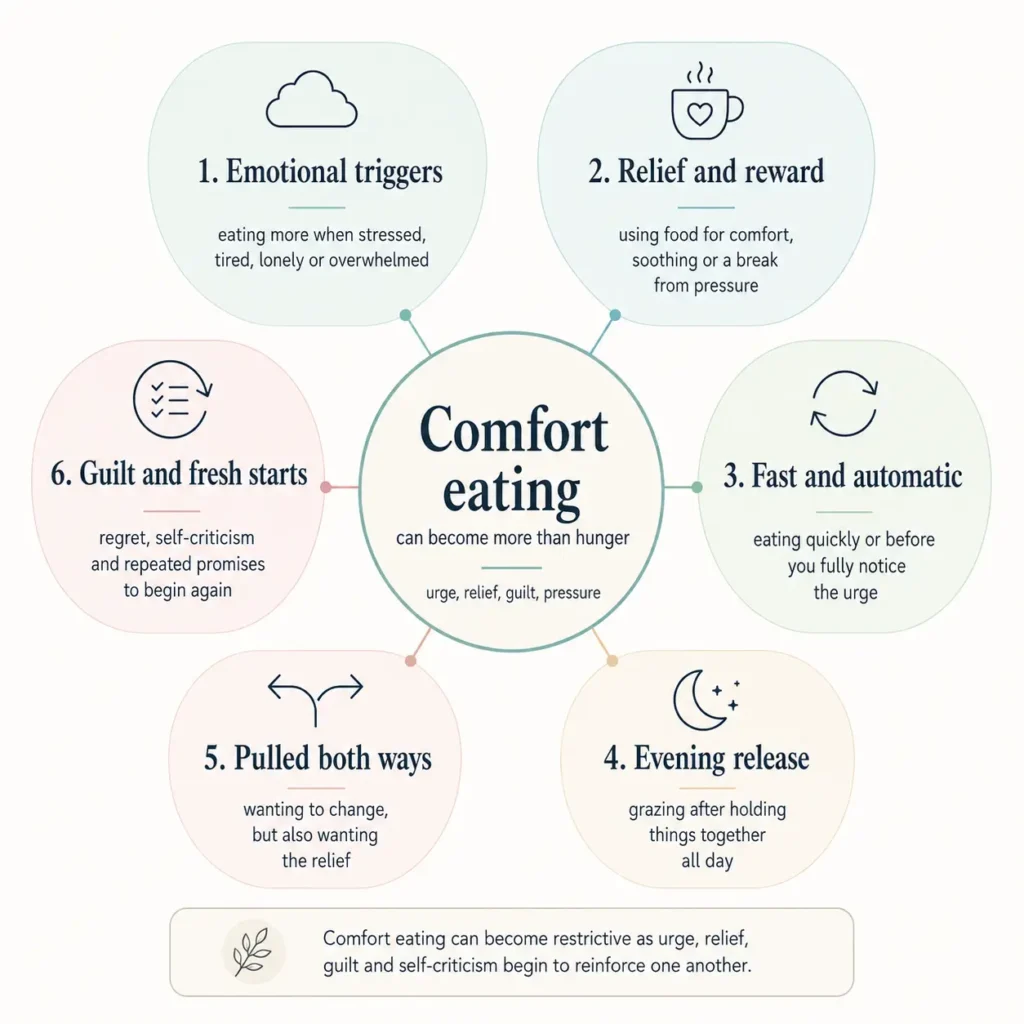
Comfort eating becomes a painful cycle of urge, relief, guilt, self-criticism, and renewed pressure. The unworkable short-term solution causes long-term
Why Comfort Eating Can Feel So Hard to Change
Comfort eating often continues because it appears to solve something in the short term. Food may seem to reduce stress, create comfort, mark the end of the day, fill a gap, soften difficult feelings, or offer a quick sense of reward when life feels demanding. The difficulty is that short-term relief can strengthen the habit loop over time.
A self-reinforcing pattern can develop: stress, emotion, tiredness, or boredom triggers an urge to eat; the mind predicts comfort, relief, or reward; the urge becomes stronger and harder to ignore; you eat, or tell yourself you will restart tomorrow; relief follows briefly — but guilt, frustration, or self-criticism may follow later, and the association between food and emotional relief becomes a little stronger each time.
Over time, the pattern can feel less like a free choice and more like something that happens automatically, especially in certain moods, places, routines, or times of day. The issue is not simply a lack of willpower. It is often a learned habit loop involving emotion, urge, relief, repetition, and self-criticism.
How Hypnotherapy May Help with Comfort Eating
Comfort eating hypnotherapy is not simply about removing cravings or making certain foods seem unpleasant. The work is usually more useful when it addresses the wider pattern: emotional triggers, urges, routines, beliefs, self-criticism, stress, and the role food has come to play in your life.
My approach is influenced by Acceptance and Commitment Therapy (ACT), which helps people respond more flexibly to difficult thoughts, feelings, urges, and bodily sensations while taking action guided by what matters to them. You can read more on my Acceptance and Commitment Therapy in Manchester page.
With comfort eating, this may mean learning to notice urges and thoughts such as “I need something”, “I deserve this”, or “I’ll start again tomorrow” without automatically acting on them. The aim is not to wait until every craving or difficult feeling has disappeared. It is to change your relationship with urges, make room for discomfort where needed, and help your longer-term choices carry more weight than the short-term pull of relief, escape, or reward.
Sessions are tailored to you and to the particular way comfort eating shows up in your life. Depending on the pattern, the work may involve:
- understanding your comfort eating pattern clearly — its emotional, situational, and routine-based triggers
- using hypnosis to support calmer, steadier internal responding to urges and cravings
- reducing automatic eating and increasing choice in the moment
- working with the stress, boredom, loneliness, anger, or overwhelm that often sits underneath the urge
- changing the emotional meaning of food as comfort or escape
- mental rehearsal for evenings, stress, shopping, social situations, or other high-risk moments
- noticing and unhooking from thoughts such as “just tonight” or “I’ve already ruined it”, and developing more compassionate self-talk after setbacks
- strengthening self-care, boundaries, and follow-through
- small between-session practices, where helpful
ACT gives the work a clear direction: less struggle with urges and difficult feelings, more movement towards health, self-care, and the kind of life you want food to support rather than limit. Hypnosis supports this by helping you mentally rehearse new responses to familiar eating triggers. For example, we might practise noticing the thought “I need this to cope” as a thought, allowing an urge to rise and fall, and choosing a response that fits your longer-term wellbeing.
A Brief Example of How the Work May Unfold
Someone might come for help because they eat well during the day, then comfort eat in the evening when tired, stressed, or emotionally flat. On the surface, they may describe the problem as, “I know what I should do, but I just can’t stop myself.”
When we look more closely, the pattern usually has several parts: holding stress in during the day, becoming tired or emotionally overloaded by evening, craving food as comfort or a way to switch off, thoughts such as “I deserve this” or “I’ll start again tomorrow”, and eating quickly or automatically. Guilt or disappointment often follows, and the self-criticism that comes with it adds more pressure to the next day.
The work would then address the pattern from several angles. We might look at what emotions or pressures are driving the eating, what food is doing in the short term, how self-criticism affects the cycle, and what the person wants to be able to do differently.
Hypnosis may be used to rehearse steadier responses to urges, strengthen a more compassionate and purposeful approach to self-care, and support different choices in familiar trigger situations. The work is not only about eating less. It is about helping the person build a different relationship with urges, emotions, comfort, and self-care.
When This Approach May Be a Good Fit
This approach may suit you if comfort eating, emotional eating, stress eating, or overeating is limiting your confidence, health, self-care, or sense of control.
You do not need to arrive feeling completely clear or motivated. Many people feel conflicted: part of them wants to change, while another part still relies on food for relief, reward, or comfort. Part of the work is to understand that conflict and strengthen your ability to act in line with what matters.
This approach may be especially relevant if comfort eating is linked with stress, anxiety, low mood, boredom, emotional overload, self-criticism, poor boundaries, exhaustion, or habit loops.
What helps is a willingness to look honestly at the pattern, try new ways of responding, and, where appropriate, practise small changes between sessions. If you want thoughtful, active support to understand and change a comfort eating pattern, we can discuss whether this approach seems suitable during the consultation.
Eating Difficulties, Medical Support, and Safety
Comfort eating and emotional eating can sometimes overlap with binge eating, restrictive dieting, purging, body image distress, depression, trauma, diabetes, medication effects, hormonal changes, or other physical and mental health issues.
Hypnotherapy can be helpful where habits, urges, stress, anxiety, or emotional regulation are part of the pattern, but it is not a substitute for medical, nutritional, or eating-disorder support where that is needed.
If you are binge eating frequently, purging, severely restricting food, rapidly losing or gaining weight, feeling out of control around food, or concerned about your physical or mental health, it is sensible to speak with your GP or another appropriate healthcare professional. If an eating disorder may be present, specialist support may be important.
We can still discuss whether hypnotherapy may be a useful part of your wider support, but safety and appropriate care come first.
What to Expect Next
The first step is usually a consultation. We can talk through how comfort eating affects you, when it tends to happen, what you have already tried, and what you would like to be different.
I will ask questions to help us understand the pattern more clearly and explain how I may be able to help. There is no pressure to make a decision on the spot. You are welcome to take time afterwards to decide whether you would like to go ahead.
You can also read more about the wider process on my page about what to expect from hypnotherapy.
Contact me
Please use this form for general enquiries. I will use the details you provide to respond to your enquiry in line with my Privacy Policy. This form is not monitored for urgent or crisis support. If you are in immediate danger, call 999 or go to A&E.
Arrange a Consultation
If you would like to discuss whether comfort eating hypnotherapy in Manchester may be suitable for you, you are welcome to get in touch and arrange your free 60-minute consultation, held online or at my private Manchester city centre office on Deansgate. I work with comfort eating, emotional eating, stress eating, food cravings, and related habit or anxiety patterns.
To take the next step, use the contact form or call me on 07790 506375.