
Blushing Therapy in Manchester
Blushing, shaking hands, and excessive sweating can become distressing when they feel visible, uncontrollable, or embarrassing. For some people, the fear of showing anxiety becomes as difficult as the anxiety itself. You may begin to worry not only about the situation, but about whether other people will notice your face, hands, voice, body, or physical reactions.
I’m Adrian Tannock, a CNHC-registered hypnotherapist based in Manchester city centre. Since 2005, I have helped adults with anxiety, social anxiety, low confidence, self-consciousness, facial blushing anxiety, shaking hands anxiety, excessive sweating anxiety, fear of judgement, and related patterns using practical, psychologically informed hypnotherapy tailored to the person rather than a one-size-fits-all script.
My aim is not to promise that you will never blush, shake, or sweat again. These are normal human body responses. The aim is to help reduce the fear, avoidance, and self-monitoring that can build around those reactions, so visible anxiety has less power over your choices.

CNHC registered · Senior member of the General Hypnotherapy Register · Practising hypnotherapy in Manchester since 2005 · Private office on Deansgate · Registered and insured to practise
Facial Blushing, Shaking Hands, and Visible Anxiety
Blushing, shaking, or sweating can become especially difficult when attention turns towards you. The fear may appear in social situations, work meetings, presentations, interviews, dating, group conversations, conflict, performance situations, or moments where you feel put on the spot.
You may recognise some of the following:
- worrying that people will notice you blushing, shaking, or sweating
- feeling anxious before meetings, presentations, social events, or conversations
- becoming highly self-conscious when attention turns towards you
- trying to hide your face, hands, voice, clothing, or body
- avoiding situations where you might feel exposed
- feeling panicky when you notice heat in your face, shaky hands, or sweating
- monitoring your body for signs that symptoms are starting
- worrying that visible anxiety makes you look weak, strange, guilty, or incompetent
- avoiding eye contact or trying to get through conversations quickly
- choosing clothes, make-up, or situations mainly to hide symptoms
- replaying social moments afterwards and criticising how you appeared
- feeling frustrated because the fear of blushing, shaking, or sweating seems to make it more likely to happen
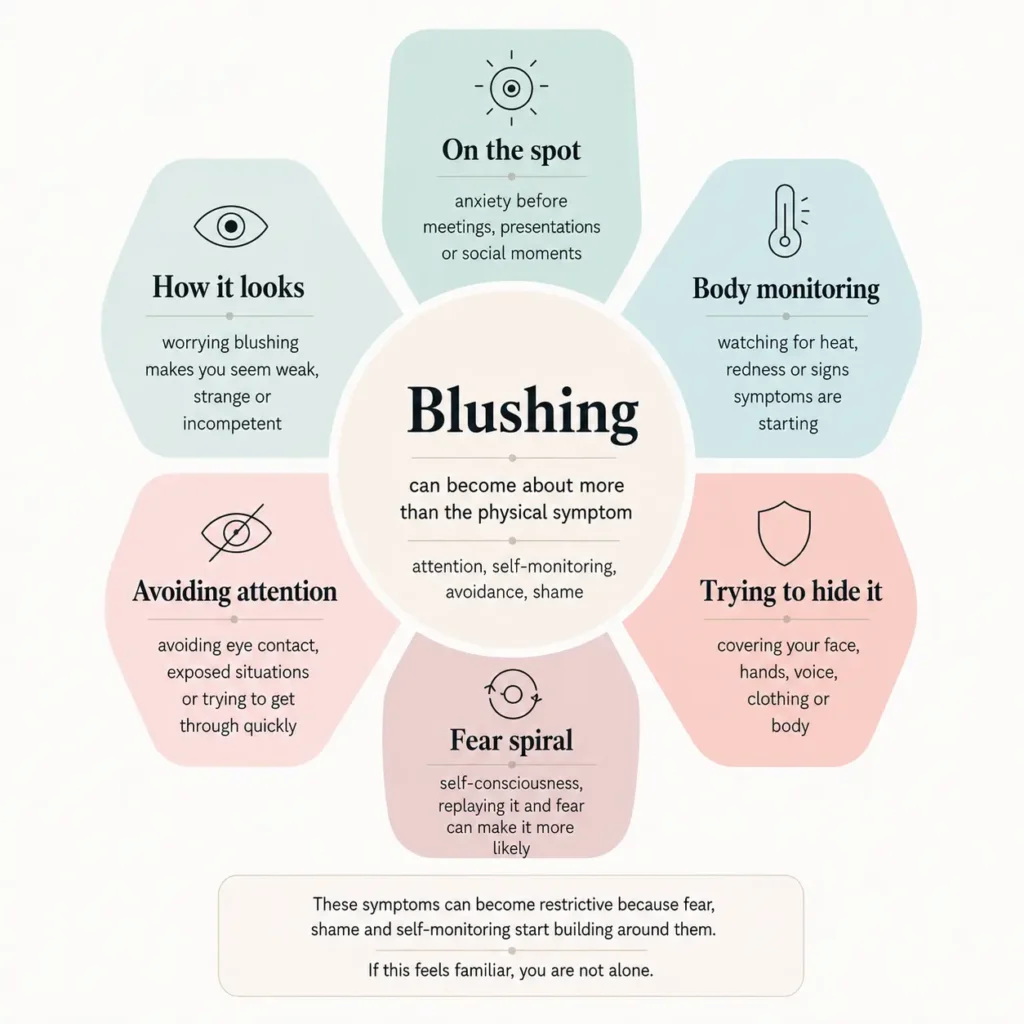
These symptoms can become restrictive not only because of the physical sensations themselves, but because of the fear, shame, and self-monitoring that build around them.
The fact that your body reacts visibly does not mean there is something wrong with you. The work is about changing your relationship with those reactions so they have less power over your choices.
How Blushing, Shaking, and Sweating Can Keep Themselves Going
Blushing, shaking, and sweating are body responses linked with arousal, threat, attention, and the nervous system. They can become more intense when you start treating them as dangerous, humiliating, or unacceptable. Many of the things people do to feel safer, such as hiding, monitoring, rushing, or avoiding eye contact, make complete sense — but they can accidentally keep the problem going.
A self-reinforcing pattern can then develop: a social or performance situation triggers anxiety or self-consciousness; the mind predicts embarrassment, judgement, or exposure; the body becomes more activated and you notice heat, shaking, or sweating; attention turns inward towards the symptom; you try to hide, control, escape, or monitor; relief follows briefly when the situation ends — and each time, the fear of visible symptoms becomes a little more believable and more likely to return.
Some coping strategies help in the moment, but can quietly teach the mind that being seen is only manageable if you stay hidden, rushed, or tightly controlled. Over time, life can become organised around avoiding being seen. You may speak less, withdraw from opportunities, avoid dating, dread meetings, turn down presentations, or keep yourself smaller than you want to be.
The issue is not simply the body response. It is the fear of the body response, and the way that fear can start to control behaviour.
How Hypnotherapy May Help with Blushing, Shaking, and Sweating
Hypnotherapy for blushing, shaking, and sweating is not simply about trying to force the body to stay calm. The work is usually more useful when it addresses the wider pattern: what triggers the fear, what your mind predicts, what happens in your body, and what you do to avoid or control the symptoms.
A useful part of the work is often learning to shift attention away from constantly checking how you are coming across, and back towards the conversation, task, or person in front of you.
My approach is also informed by Acceptance and Commitment Therapy (ACT), which helps people respond more flexibly to difficult thoughts, feelings, and bodily sensations while taking action guided by what matters to them. You can read more on my Acceptance and Commitment Therapy in Manchester page. With blushing, shaking, or sweating, this may involve learning to notice thoughts such as “everyone can see” or “I need to hide this” without automatically rushing, avoiding eye contact, or monitoring your body.
The aim is not to wait until every anxious thought or physical sensation has disappeared. It is to help visible anxiety have less control over what you avoid, how much you monitor yourself, and how freely you participate.
Depending on your needs, the work may involve:
- understanding your specific self-conscious anxiety pattern — its triggers and self-protective habits
- reducing the grip of anxious predictions and self-critical thoughts
- using hypnosis to help settle the body’s threat response in social or performance situations
- responding differently to heat, shaking, sweating, tension, or voice changes
- reducing avoidance, hiding, over-control, and excessive self-monitoring
- mental rehearsal for meetings, presentations, or social situations that currently feel exposing
- developing a more compassionate and realistic relationship with yourself
- strengthening self-esteem and self-trust
- looking at what this problem has been stopping you from doing, and what you would like to move back towards
- simple between-session practices, where helpful
ACT gives the work a clear direction: less struggle with visible anxiety, more movement towards participation, confidence, and self-expression. Hypnosis supports this by helping you mentally rehearse steadier responses to situations where you currently feel exposed.
Gentle, Planned Practice Steps
Part of the work may involve gentle, planned practice steps around situations that trigger blushing, shaking, or sweating. This does not mean throwing you into difficult situations, humiliating you, or pushing you too far too quickly.
The aim is not to prove that you will never blush, shake, or sweat. It is to practise staying present, reducing self-monitoring, and taking part even if some visible anxiety is there.
Depending on the person, this might involve:
- imagining specific social or performance situations while staying grounded
- rehearsing conversations, meetings, or presentations in hypnosis
- gradually reducing hiding, checking, or safety behaviours
- practising staying present when heat, shaking, or sweating appears
- taking small real-world steps towards situations that have been avoided
- learning to bring attention back to the conversation, task, or person in front of you
- building confidence through repeated, manageable experiences
The pace matters. The aim is not to overwhelm you. The aim is to help you build confidence, experience, and choice in a way that is safe, realistic, and useful.
A Brief Example of How the Work May Unfold
Someone might come for help because they blush in meetings and dread being asked a question. On the surface, they may describe the problem as, “I go bright red and then I can’t think clearly.”
When we look more closely, the pattern usually has several parts: anticipating embarrassment before the meeting begins, worrying that blushing will make them look incompetent, and monitoring their face for signs of heat. This often means avoiding speaking unless absolutely necessary, or rushing their words to get the attention away from them — then replaying the meeting afterwards, focused on how they looked, and avoiding future situations where they may be noticed.
The work would then address the pattern from several angles. We might look at the fear predictions involved, how attention turns inward, what avoidance and self-monitoring are doing in the short and long term, and what the person wants to be able to do differently.
Hypnosis may be used to rehearse a steadier internal response, strengthen confidence in being seen, and support a different relationship with blushing or visible anxiety. We may also plan gentle practice steps — speaking briefly in lower-pressure situations, reducing safety behaviours, and slowly rebuilding confidence in situations that have become loaded. The work is not only about reducing blushing. It is also about helping the person become less governed by the fear of being seen.
When This Approach May Be a Good Fit
This approach may suit you if blushing, shaking hands, or excessive sweating is limiting your confidence, work, social life, relationships, or ability to express yourself.
You do not need to arrive feeling ready to face everything immediately. Part of the work is to make sense of the pattern together and proceed in a way that feels careful, respectful, and realistic.
This approach may be especially relevant if your symptoms are linked with social anxiety, low self-esteem, fear of public speaking, presentation anxiety, work-based anxiety, dating anxiety, people-pleasing, perfectionism, shame, self-consciousness, or avoidance.
What helps is a willingness to look honestly at how the pattern operates, try new ways of responding, and, where appropriate, practise small steps between sessions.
If you want thoughtful, active support to understand and change the anxiety pattern around blushing, shaking, or sweating, we can discuss whether this approach seems suitable during the consultation.
Medical and Physical Considerations
Blushing, shaking, and sweating can be linked with anxiety and self-consciousness, but they can also have physical or medical contributors.
Excessive sweating may be related to hyperhidrosis, medication, hormonal changes, thyroid problems, infection, alcohol, stimulants, or other health factors. Shaking hands may be related to anxiety, caffeine, medication, essential tremor, blood sugar, thyroid issues, neurological factors, or other causes. Persistent flushing or facial redness may also overlap with skin conditions such as rosacea.
Hypnotherapy can be helpful when anxiety, fear, self-consciousness, or avoidance is part of the pattern, but it is not a substitute for medical assessment. If your symptoms are severe, sudden, worsening, medically unexplained, or you are unsure what is causing them, it is sensible to speak with your GP or another appropriate healthcare professional.
We can still discuss whether hypnotherapy may be a useful part of your wider support, but safety and appropriate care come first.
What to Expect Next
The first step is usually a consultation. We can talk through how blushing, shaking, or sweating affects you, what situations trigger the fear, what you have already tried, and what you would like to be different.
I will ask questions to help us understand the pattern more clearly and explain how I may be able to help. If gentle practice steps may be useful, we can discuss how this could be approached safely, realistically, and with your consent.
There is no pressure to make a decision on the spot. You are welcome to take time afterwards to decide whether you would like to go ahead.
You can also read more about the wider process on my page about what to expect from hypnotherapy.
Contact me
Please use this form for general enquiries. I will use the details you provide to respond to your enquiry in line with my Privacy Policy. This form is not monitored for urgent or crisis support. If you are in immediate danger, call 999 or go to A&E.
Arrange a Consultation
If you would like to discuss whether blushing therapy in Manchester may be suitable for you, you are welcome to get in touch and arrange your free 60-minute consultation, held online or at my private Manchester city centre office on Deansgate. I also work with social anxiety, public speaking anxiety, shaking hands anxiety, excessive sweating anxiety, and related anxiety patterns.
To take the next step, use the contact form or call me on 07790 506375.