Panic Attack Therapy in Manchester
Panic attacks can feel frightening, intense, and difficult to control. They may involve a racing heart, tight chest, breathlessness, dizziness, trembling, nausea, sweating, tingling, unreality, or a sudden fear that something terrible is about to happen.
For some people, the panic attack itself becomes only part of the problem. The fear of having another panic attack can begin to shape behaviour: avoiding places, checking bodily sensations, needing escape routes, seeking reassurance, or organising life around staying safe.
I’m Adrian Tannock, a CNHC-registered hypnotherapist based in Manchester city centre. Since 2005, I have helped adults with panic attacks, anxiety, fear responses, avoidance patterns, self-consciousness, and related difficulties using practical, psychologically informed hypnotherapy tailored to the person rather than a one-size-fits-all script.
My aim is not to tell you to “just calm down”. Panic is not changed by being lectured at. The work is about understanding how the panic pattern operates, helping you respond differently to the sensations and fear, and supporting you to take useful steps in everyday life.

CNHC registered · Senior member of the General Hypnotherapy Register · Practising hypnotherapy in Manchester since 2005 · Private office on Deansgate · Registered and insured to practise
Panic Attacks, Fear of Panic, and Avoidance
Panic attacks can happen in many different settings. Some people experience them in shops, meetings, public transport, motorways, lifts, restaurants, queues, social situations, or when far from home. Others experience panic when resting, trying to sleep, exercising, or noticing ordinary body sensations.
You may recognise some of the following:
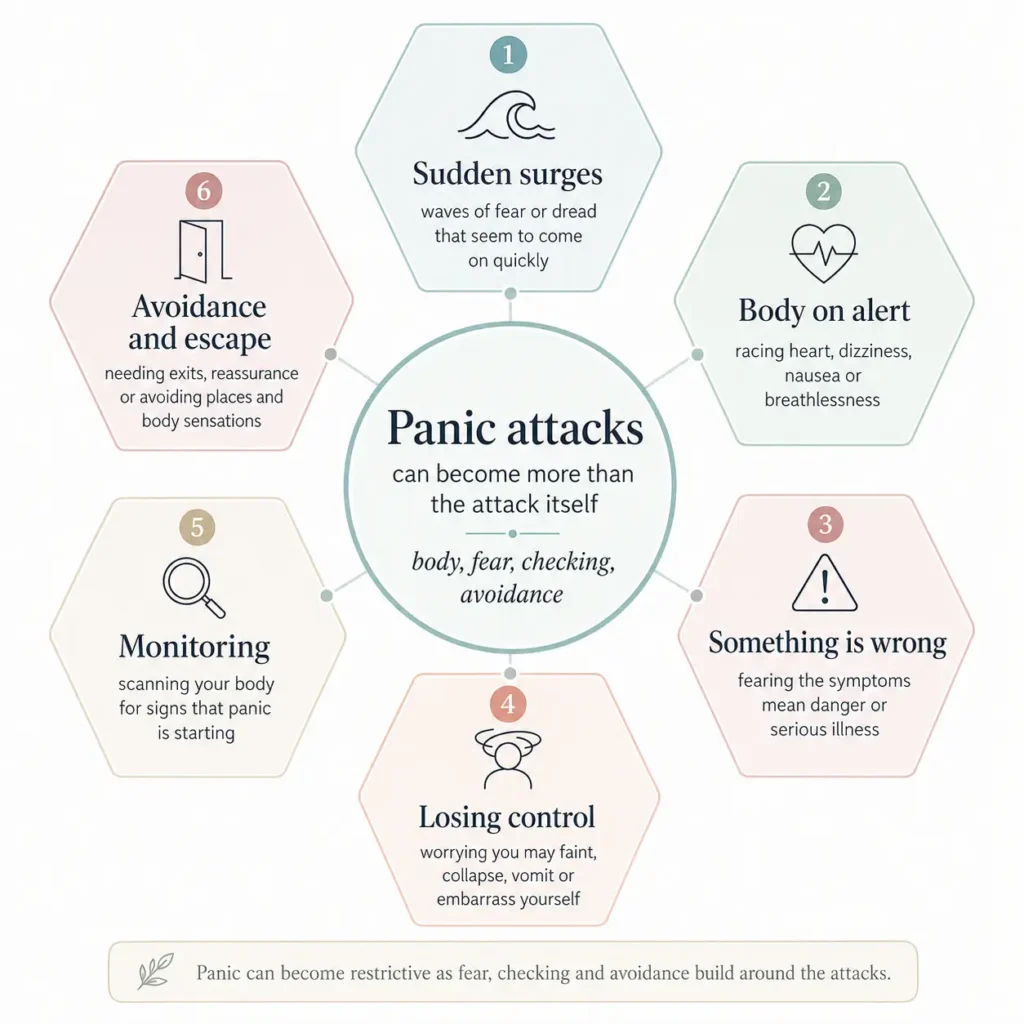
- sudden surges of fear or dread
- a racing heart, tight chest, dizziness, nausea, or breathlessness
- feeling shaky, hot, unreal, detached, or out of control
- worrying that panic symptoms mean something is seriously wrong
- fearing that you might faint, collapse, vomit, lose control, or embarrass yourself
- monitoring your body for signs that panic is starting
- avoiding places where panic has happened before
- needing exits, escape plans, or reassurance before doing things
- avoiding exercise, caffeine, travel, crowds, or unfamiliar places because of body sensations
- feeling anxious about being alone, far from home, or somewhere you cannot easily leave
- becoming frustrated because you know panic passes, but still feel frightened when it starts
Panic can become restrictive not only because of the attacks themselves, but because of the fear, checking, and avoidance that can build around them.
How Panic Attacks Can Keep Themselves Going
Panic attacks are often maintained by a cycle of bodily sensation, threat prediction, fear, and avoidance. A sensation appears — perhaps a faster heartbeat, dizziness, tightness, heat, breathlessness, or a strange feeling of unreality — and the mind interprets it as dangerous. The body then becomes more alarmed, which creates more sensations, which seem to confirm that something is wrong, and the panic escalates.
A self-reinforcing pattern can then develop: a sensation, situation, or thought triggers anxiety; the mind predicts danger, collapse, or loss of control; the body becomes more activated and the sensations grow stronger; you monitor, check, escape, seek reassurance, or avoid; relief follows briefly — and each time, the fear of panic becomes a little more believable and more likely to return.
This is why panic can feel so convincing in the moment, even when part of you knows the attack will pass. The problem is not a lack of logic. It is a powerful fear loop involving the body, attention, interpretation, and avoidance. Some coping strategies help in the moment, but others quietly teach the mind that panic is only manageable if you escape, check, avoid, or stay tightly controlled.
Fear of Panic
Many people seek help not only because of panic attacks, but because of fear of panic.
You may begin to avoid situations where a panic attack would feel difficult, embarrassing, or unsafe. This can make life gradually smaller. A person might avoid driving, travelling, meetings, presentations, shops, public transport, exercise, social events, eating out, or being somewhere without an easy exit.
Over time, the question becomes less “Is this situation actually dangerous?” and more “What if I panic there?” Therapy becomes more useful when we understand both parts of the problem: the panic symptoms themselves and the fear-driven behaviour that develops around them.
How Hypnotherapy May Help with Panic Attacks
Panic attack hypnotherapy is not simply about relaxation. Relaxation may be useful, but the work usually needs to address the wider pattern: what triggers panic, how sensations are interpreted, where attention goes, what you do to feel safe, and how avoidance keeps the fear alive.
My approach is influenced by Acceptance and Commitment Therapy (ACT), which helps people respond more flexibly to difficult thoughts, feelings, and bodily sensations while taking action guided by what matters to them. You can read more on my Acceptance and Commitment Therapy in Manchester page.
With panic attacks, this may involve learning to notice thoughts such as “I can’t cope”, “I’m going to collapse”, or “I need to escape” without automatically obeying them, fighting the sensations, or leaving the situation. The aim is not to wait until every anxious thought or sensation has disappeared. It is to help panic have less control over what you avoid, where you go, and how freely you live.
Sessions are tailored to you and to the particular way panic shows up in your life. Depending on the pattern, the work may involve:
- understanding your panic and avoidance pattern clearly — its triggers, sensations, predictions, and the responses that keep it going
- reducing fear of bodily sensations and helping you relate differently to catastrophic thoughts
- using hypnosis to help settle the body’s threat response and rehearse steadier ways of responding
- reducing avoidance, checking, reassurance-seeking, and escape behaviours, gradually and at a manageable pace
- learning to stay more present when anxiety rises
- building confidence in situations you have started to avoid, and taking realistic steps in that direction
- small between-session practices, where helpful
ACT gives the work a clear direction: less struggle with panic sensations, more movement towards the life panic has restricted. Hypnosis supports this by helping you mentally rehearse steadier responses to feared sensations and situations. For example, we might practise noticing the thought “I need to escape” as a thought, making room for some physical anxiety, and taking one small step towards staying present rather than automatically leaving.
Gentle, Planned Steps Towards Life Again
For some people, panic leads to avoidance. Avoidance may bring short-term relief, but it can also make the world feel smaller and more threatening over time.
Where appropriate, the work may include gentle, planned steps towards situations you have been avoiding. This does not mean throwing you into panic, forcing exposure, or pushing you too far too quickly. The aim is not to prove that you will never feel anxious. It is to practise responding differently when anxiety or panic sensations appear, so you can build confidence through repeated, manageable experience — reconnecting gradually with the activities, places, and relationships that panic has interrupted.
The pace matters. The work should be realistic, collaborative, and respectful.
A Brief Example of How the Work May Unfold
Someone might come for help because they have started avoiding busy places after several panic attacks. On the surface, they may describe the problem as, “I’m scared I’ll panic and won’t be able to get out.”
When we look more closely, the pattern usually has several parts: noticing body sensations such as heat, dizziness, or a racing heart; interpreting those sensations as signs that panic is about to take over; scanning for exits; seeking reassurance before going somewhere; and avoiding queues, shops, public transport, or unfamiliar places. Avoiding brings brief relief, but confidence tends to shrink over time.
The work would then address the pattern from several angles: the feared predictions, the body’s alarm response, the attention loop, the urge to escape, and the safety behaviours that feel necessary but may be keeping the fear alive.
Hypnosis may be used to rehearse a steadier internal response, strengthen confidence in handling sensations, and support a different relationship with situations that currently trigger fear. The work is not only about reducing panic symptoms. It is also about helping the person regain movement, choice, and confidence in everyday life.
When This Approach May Be a Good Fit
This approach may suit you if panic attacks, anxiety attacks, or fear of panic are restricting your life and you want therapy to be practical, collaborative, and focused on meaningful change.
You do not need to arrive feeling confident or fully ready to face the fear. Many people seek help precisely because they feel stuck, frightened, or unsure where to begin. Part of the work is to understand the pattern clearly and find a way forward that is realistic rather than overwhelming.
This approach may be especially relevant if panic is linked with avoidance, social anxiety, driving anxiety, public transport, fear of flying, claustrophobia, health anxiety, low confidence, or a growing fear of being far from safety.
If you want thoughtful, active support to understand and change a panic pattern, we can discuss whether this approach seems suitable during the consultation.
Medical and Safety Considerations
Panic attacks can produce intense physical symptoms. Although panic itself is common and treatable, symptoms such as chest pain, breathlessness, dizziness, fainting, palpitations, or sudden changes in physical health should not simply be assumed to be anxiety.
If your symptoms are new, severe, sudden, medically unexplained, or you are unsure whether they may have a physical cause, it is sensible to speak with your GP or another appropriate healthcare professional.
If you think you may be having a medical emergency, or you feel at risk, call 999 or go to A&E.
Hypnotherapy can be helpful when panic, fear, and avoidance are part of the pattern, but it is not a substitute for urgent or necessary medical or mental health care. We can still discuss whether hypnotherapy may be a useful part of your wider support, but safety and appropriate care come first.
What to Expect Next
The first step is usually a consultation. We can talk through how panic affects you, what situations trigger it, what you have already tried, and what you would like to be different.
I will ask questions to help us understand the pattern more clearly and explain how I may be able to help. If gentle, planned steps may be useful, we can discuss how this could be approached safely, realistically, and with your consent.
There is no pressure to make a decision on the spot. You are welcome to take time afterwards to decide whether you would like to go ahead.
You can also read more about the wider process on my page about what to expect from hypnotherapy.
Contact me
Please use this form for general enquiries. I will use the details you provide to respond to your enquiry in line with my Privacy Policy. This form is not monitored for urgent or crisis support. If you are in immediate danger, call 999 or go to A&E.
Arrange a Consultation
If you would like to discuss whether panic attack therapy in Manchester may be suitable for you, you are welcome to get in touch and arrange your free 60-minute consultation, held online or at my private Manchester city centre office on Deansgate. I work with panic attacks, fear of panic, and related anxiety patterns.
To take the next step, use the contact form or call me on 07790 506375.