
Hypnotherapy for Anxiety in Manchester
Anxiety can affect how you think, feel, behave, and relate to everyday situations. It may involve constant overthinking, physical tension, panic-like symptoms, self-consciousness, avoidance, or a sense that life is becoming smaller around what feels safe.
This page explains how I use hypnotherapy for anxiety in Manchester, how anxiety can keep itself going, and what working together may involve.
I’m Adrian Tannock, a CNHC-registered hypnotherapist who runs Lasting Change Hypnotherapy Manchester. Since 2005, I have helped adults with anxiety, overthinking, panic, social fears, and related patterns using practical, psychologically informed therapy tailored to the person rather than a one-size-fits-all script.
My aim is to help you understand what keeps anxiety going, develop steadier ways of responding, and take useful steps in everyday life, even when anxiety or uncertainty is present.

CNHC registered · Senior member of the General Hypnotherapy Register · Practising hypnotherapy in Manchester since 2005 · Private office on Deansgate · Registered and insured to practise
Anxiety, Avoidance, and Overthinking
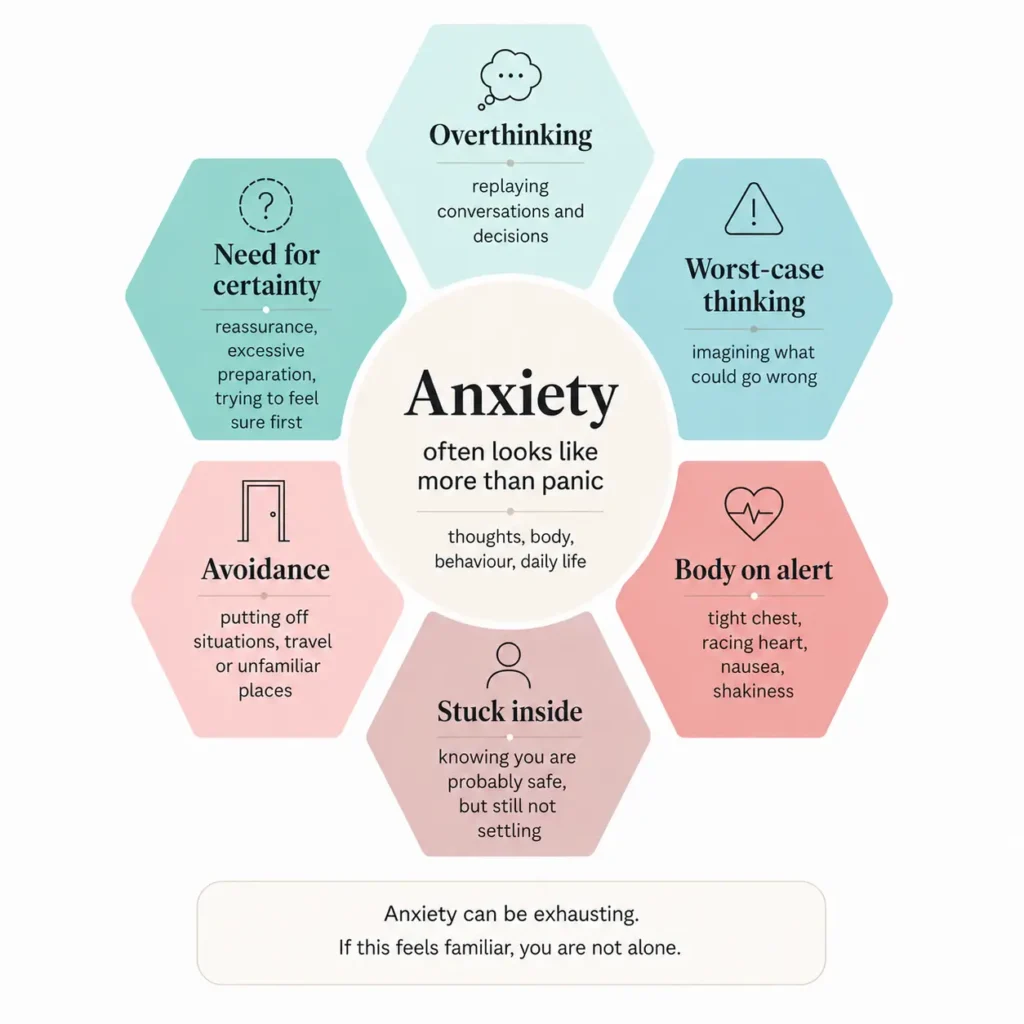
Anxiety does not always look like obvious panic. Sometimes it shows up as a mind that will not switch off, a body that stays tense and alert, or a growing habit of avoiding situations that feel difficult, exposed, or uncertain.
You may recognise some of the following:
- overthinking conversations, decisions, or possible problems
- catastrophising and imagining worst-case outcomes
- feeling constantly on edge or unable to relax
- physical symptoms such as a tight chest, racing heart, nausea, blushing, or shakiness
- avoiding social situations, meetings, travel, or unfamiliar places
- needing reassurance, certainty, or excessive preparation before acting
- feeling trapped between knowing something is probably safe and still being unable to settle
- worrying about panic attacks or feeling out of control
- feeling self-conscious around other people
- becoming increasingly frustrated with yourself for not being able to “just get over it”
Anxiety can become exhausting not only because of how it feels, but because of how much life begins to organise itself around trying not to trigger it.
How Anxiety Can Keep Itself Going
Anxiety is not usually maintained by fear alone. It is often maintained by the understandable things people do in response to fear.
You might avoid a situation, over-prepare, seek reassurance, mentally rehearse every possibility, monitor your body for signs of panic, or try to force anxious thoughts out of your mind. Some of these responses help in the moment. Others quietly teach the mind that the situation really is dangerous, or that you cannot cope without avoiding, checking, controlling, or seeking reassurance.
A self-reinforcing pattern can then develop. A situation, thought, or sensation triggers anxiety; the mind predicts danger, embarrassment, failure, or loss of control; and the body becomes more activated. You avoid, escape, overthink, check, or seek reassurance, and relief follows briefly — but each time, the anxious pattern becomes a little more believable and a little more likely to return.
Over time, confidence can shrink. Life may become increasingly organised around preventing anxiety rather than moving towards what matters.
The Problem with Overthinking
Overthinking often begins as an attempt to stay safe, avoid mistakes, prepare properly, or feel more in control. Sometimes thinking is useful. Planning, reflection, and problem-solving all have their place.
The difficulty begins when thinking becomes repetitive, threat-driven, or impossible to complete. The mind may replay conversations, rehearse future problems, analyse bodily sensations, search for certainty, or keep returning to the same question without reaching anything useful.
Part of the work may involve noticing when the mind has moved from useful problem-solving into repetitive threat-monitoring, and learning how to step back rather than keep feeding the loop.
How Hypnotherapy for Anxiety Works
Hypnotherapy for anxiety is not simply about trying to make anxious feelings disappear. The work is usually more useful when it addresses the wider pattern: what triggers the anxiety, how you respond when it appears, and how those responses may be keeping the problem going.
Sessions are tailored to you and to the particular way anxiety shows up in your life. Depending on the pattern, the work may involve:
- understanding your anxiety pattern clearly — its triggers, predictions, and the responses that keep it going
- reducing the grip of anxious thoughts and predictions
- responding differently to uncertainty, bodily sensations, and self-doubt
- changing patterns of avoidance, reassurance-seeking, and over-control
- using hypnosis to help settle an overactive threat response and rehearse steadier ways of responding
- building confidence in situations you have begun to avoid, and taking realistic steps in that direction
- small between-session practices, where helpful
Acceptance and Commitment Therapy, known as ACT, is an evidence-based psychological approach that helps people respond more flexibly to difficult thoughts, feelings, urges, and bodily sensations while taking action guided by what matters to them.
With anxiety, this may involve learning to notice thoughts such as “I won’t cope”, “something bad will happen”, or “I need to feel certain first” without automatically avoiding, checking, overthinking, or seeking reassurance.
The aim is not to wait until anxiety has disappeared before life can move forward. It is to help anxiety have less control over what you do, what you avoid, and how freely you live.
ACT gives the work a clear direction: less struggle with anxious thoughts and sensations, and more movement towards what matters. The two sides fit together — hypnosis can help your body settle and rehearse steadier responses, while the ACT work helps you move towards what matters without waiting to feel completely calm first.
For example, we might practise noticing the thought “I need to feel calm first” as a thought, making room for some uncertainty, and taking one small useful step rather than waiting for complete confidence.
The exact balance will vary. The aim is to understand the anxiety clearly and use the most relevant methods to help you respond with greater freedom, steadiness, and confidence.
A Brief Example of How the Work May Unfold
Someone might come for help with anxiety that feels constant and hard to switch off. On the surface, they may describe themselves as “always overthinking” or “unable to relax”.
When we look more closely, the pattern usually has several parts: anticipating what could go wrong, rehearsing difficult conversations or decisions, seeking reassurance before acting, avoiding situations that feel exposing or uncertain, monitoring the body for signs that anxiety is rising, and postponing useful action until they feel calmer — often while criticising themselves for not coping better.
The work would then address the pattern from several angles. We might look at how anxious thoughts are being treated, how the body responds to perceived threat, what avoidance or reassurance strategies are doing in the short and long term, and what the person wants anxiety to stop preventing them from doing.
Hypnosis may be used to help rehearse a steadier internal response, strengthen confidence in handling difficult moments, and support a different relationship with situations that currently trigger anxiety.
The work is not only about reducing anxiety. It is also about helping the person act more freely in the situations that matter to them.
When This Approach May Be a Good Fit
This approach may suit you if anxiety is interfering with your life and you want therapy to be practical, collaborative, and focused on meaningful change.
You do not need to have a perfect explanation of what is happening before getting in touch. Part of the work is to make sense of the pattern together. What helps is a willingness to look honestly at how anxiety operates, try new ways of responding, and, where appropriate, bring small parts of the work into everyday life between sessions.
This approach may be especially relevant if anxiety is linked with overthinking, panic attacks, social anxiety, avoidance, self-doubt, reassurance-seeking, physical tension, or difficulty tolerating uncertainty.
During a consultation, we can talk it through and decide together whether this way of working feels like a good fit for you.
When to Seek Additional or Urgent Support
Hypnotherapy can be helpful for anxiety patterns, but it is not a substitute for urgent or necessary medical care.
If your anxiety symptoms are severe, have changed suddenly, or you are unsure whether they may have a physical cause, it is sensible to speak with your GP or another appropriate healthcare professional.
If you are struggling to cope, feeling at risk, or need urgent mental health support, you should seek immediate help through the appropriate NHS or emergency services.
We can still discuss whether hypnotherapy may be a useful part of your wider support, but safety and appropriate care come first.
What to Expect Next
The first step is usually a consultation. We can talk through what is happening, how anxiety affects you, what you would like to change, and whether hypnotherapy seems likely to be a suitable approach.
I will ask questions to help us understand the pattern more clearly and explain how I may be able to help. There is no pressure to make a decision on the spot. You are welcome to take time afterwards to decide whether you would like to go ahead.
You can also read more about the wider process on my page about what to expect from hypnotherapy.
Contact me
Please use this form for general enquiries. I will use the details you provide to respond to your enquiry in line with my Privacy Policy. This form is not monitored for urgent or crisis support. If you are in immediate danger, call 999 or go to A&E.
Arrange a Consultation
If you would like to discuss whether hypnotherapy for anxiety in Manchester may be suitable for you, you are welcome to get in touch and arrange a consultation.
Consultations take place at my private Manchester city centre office on Deansgate.
To take the next step, please use the contact form or call me on 07790 506375.